What Is a POP Display? The Complete Guide to Point-of-Purchase Merchandising | VIGO DISPLAY
The short answer: a POP display is a branded fixture placed where a purchase decision is made, built to do four things at once: hold the product at a height people actually look at, keep it faced, carry the message without a salesperson, and survive the store for as long as the promotion runs. It is not the store's own shelving, and it is not the packaging that travels home with the product. This guide covers the vocabulary, the seven formats, how material follows service life, and the brief that gets you a quote you can compare.
In short:
- A POP display is the brand's own fixture: it arrives with the stock, carries the brand's name, and leaves when the promotion ends.
- It is not the retailer's shelving and not the packaging that goes home with the product. Those are three separate budgets.
- Four jobs decide the format: catch the eye, keep the product faced, carry the message, and survive the store.
- Seven formats cover almost every position. Choose the position first, then the format.
- Material follows service life, not taste: weeks, months or years each point to a different board, polymer or steel.
What a POP display is, and what it is not
A point-of-purchase display is the piece of retail furniture the brand owns rather than the retailer. It arrives with the stock, carries the brand's name, and usually leaves when the promotion ends. Its job is narrower than a shopfitter's and wider than a packaging designer's: present one product, or one small family of products, well enough that a shopper who had no intention of buying stops and reconsiders.
The boundary is easier to see in a table than a definition, because the four things that meet at a shelf are routinely confused in a brief, and each is paid for out of a different budget.
| Item | Who owns it | Service life | Who installs it | What it does |
|---|---|---|---|---|
| POP display | The brand | Weeks to years | Store staff, a crew, or the brand | Presents and sells one product family |
| Store fixture | The retailer | Years | The retailer's shopfitter | Holds a category, open ended |
| Packaging | The brand | Until unboxing | Nobody | Protects the product and carries legal copy |
| Signage | Brand or retailer | Days to months | Store staff | Communicates price, claim or location |
The distinction is commercial, not academic. A POP display is charged to marketing, a fixture is capital expenditure for the retailer, and packaging is a cost of goods. A brief that mixes them produces a quote at the wrong scale.
POP, POS, POSM: what the words actually mean
Point of purchase originally meant the checkout, and point of sale means the same thing; in most English-speaking markets the two are used interchangeably by brands, agencies and factories. POSM, point-of-sale materials, is the widest of the three and covers the display unit, the shelf talker, the wobbler and the hanging strip as one media family.
The label changes nothing about how the fixture is built. What changes the build is the position: floor, counter, shelf edge, aisle end, ceiling or cold cabinet. That is the one line in a brief that must be unambiguous, because a counter unit cannot be rescued for the floor by making it taller. We covered the naming question in more detail in POP display vs POS display.
Four jobs a POP display has to do at the shelf
Every program we have seen pulled out of stores failed on one of these four jobs, usually the first. Treat them as acceptance criteria rather than design principles: each can be checked in a pilot store before a roll-out is committed.
1. Put the product in the band people look at
For a standing adult, the band read without effort sits roughly 120 to 160 cm above the floor, which on a typical 180 cm gondola is the third and fourth shelf up. Product below about 90 cm reads as value or bulk; product above about 170 cm is often not read at all. A floor stand's selling shelf therefore belongs between 90 and 140 cm, with the sign above the product. A counter sits at 90 to 95 cm, so a counter unit has to lift the product another 10 to 25 cm to reach the same band.
2. Keep the shelf faced
Facing is physical work. A shopper takes the front unit, and unless something pushes the row forward the shelf develops a gap that reads as nearly sold out or discontinued. Three mechanisms solve it: gravity, a spring pusher, or staff labor on a schedule. Gravity is free and unreliable on shallow slopes, a pusher costs a component per lane, and staff labor is the first thing cut when a store is short-handed.
3. Carry the message at the right reading distance
Legibility is arithmetic. A working rule in sign work is about 25 mm of capital height per 3 m of viewing distance, so a panel read from 4 m needs capitals around 32 mm while one read from a meter can use 10 mm. Most POP copy fails in the opposite direction: six lines of feature text where three words would have been read.
4. Survive the store
Retail is hostile to anything made of paper. Floors get mopped, chiller aisles run humid, staff lean on fixtures while restocking. Corrugated board loses stiffness quickly in a damp chiller aisle, MDF swells at an exposed edge, acrylic chips at a sharp corner. Material has to match the environment as well as the promotion length.
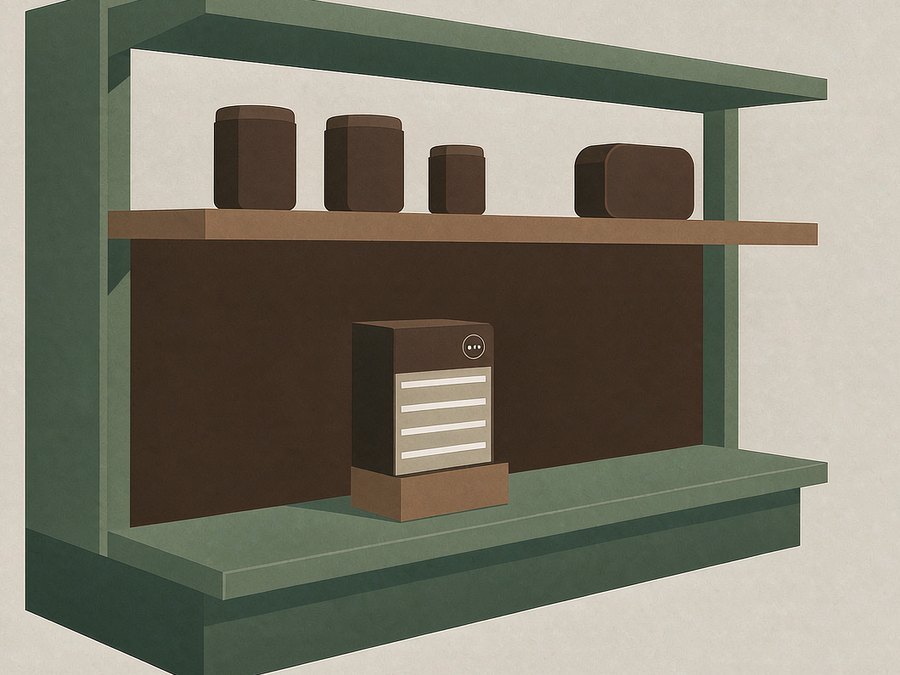
Measure five things before any drawing starts. They decide the format before the artwork does, and they are the numbers most briefs leave out:
- Bay width and shelf pitch, so the unit fits a real bay and not an average one.
- Shelf depth and the height of the front lip, which decide whether a clip-on part will hold.
- Height of the product face as it will sit, not as it sits on a drawing.
- Aisle width, because a stand that narrows it below the local egress minimum gets removed.
- Ceiling or grid height, if anything is to hang.
The seven formats, and where each one belongs
Almost every POP display sold is a variation of seven formats, and the format is decided by the position it will occupy before any artwork is drawn. Doing it the other way round, drawing a beautiful unit and then hunting for somewhere to put it, is how brands end up with a floor stand specified for a counter.
| Format | Where it sits | Typical size | Best for | What usually goes wrong |
|---|---|---|---|---|
| Floor stand | Open floor, aisle end, promotional zone | 40 to 60 cm footprint, 150 to 180 cm tall | Multi-SKU brand blocks, seasonal pushes | Too tall for the sightline, top heavy when half empty |
| Counter unit | On the counter or a till-side ledge | 25 to 40 cm wide | Impulse lines at a low price point | Blocks the cashier's reach, or cannot hold a case pack |
| Shelf-edge strip | Clipped to the front of an existing shelf | Bay width, 4 to 10 cm tall | Price and claim on stocked lines | Falls off when the shelf lip is the wrong profile |
| Sidekick | Hooked to the side panel of a gondola | 20 to 30 cm deep | Adding SKUs without taking floor space | Overloaded past the panel's rating |
| Shipper or dump bin | Floor, usually on a pallet base | 60 by 80 cm, or a quarter pallet | High volume, low unit value, short promotion | Softens and collapses when the board takes up moisture |
| Hanging or suspended | Ceiling, wire, or a grid above the aisle | 30 to 50 cm drop | Categories with no shelf space | Installed once, then never re-merchandised |
| Chiller insert | Inside a chiller, freezer or locked cabinet | Matched to the shelf, 20 to 35 cm deep | Chilled drinks, high-theft categories | Condensation and cold behavior ignored in the material choice |
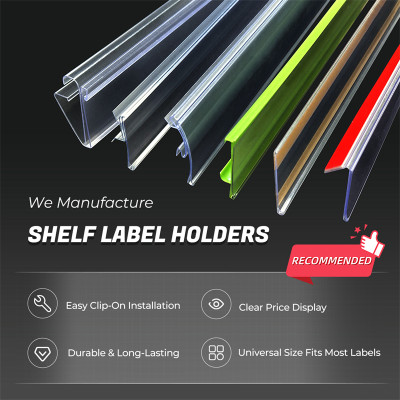
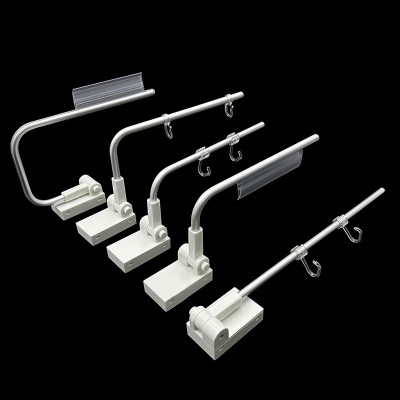
The components that make these formats work are a subject of their own, and we have written them up individually: choosing display hooks, dividers versus pushers, shelf label holders and hanging display strips.
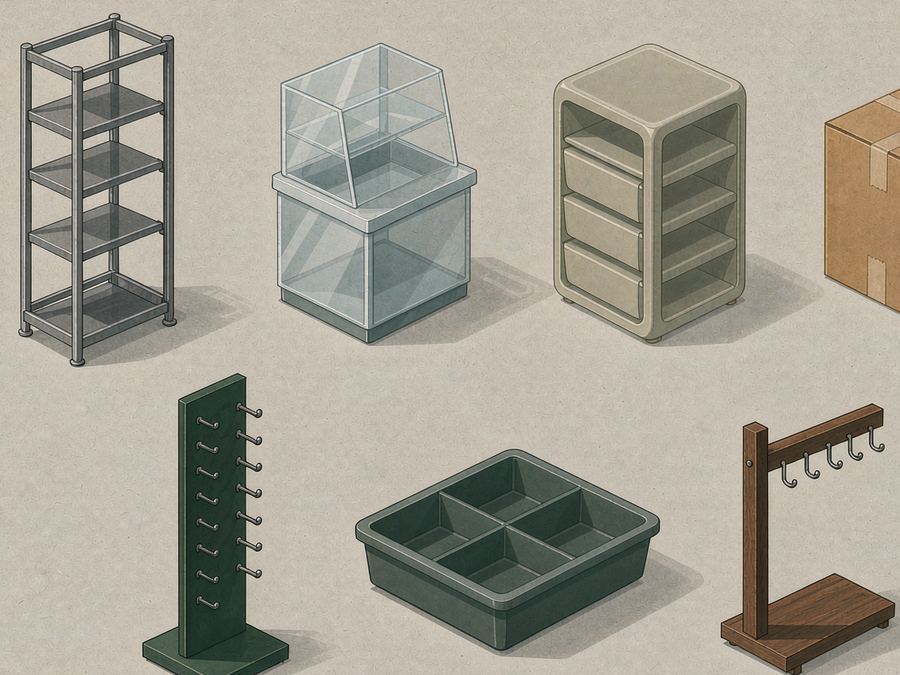
A format is a set of commitments made before anything is drawn: how much floor or shelf it takes, how tall it stands, how it is loaded, and how it dies. Those four commitments set the material, the tooling and the freight.
It is also why a display for a chain and one for an independent store are rarely the same object: the chain specifies the bay and the install crew, the independent tells you the aisle is 90 cm wide and expects the unit to arrive assembled.
Material and format follow lifespan, not taste
The most expensive mistake here is a mismatch between material and program length. A two-year steel fixture built for a six-week promotion wastes money on tooling and freight; a printed board unit specified for an eighteen-month brand block is sagging by month four.
| Tier | Typical service life | Materials | How it is joined | Main cost driver |
|---|---|---|---|---|
| Temporary | 4 to 12 weeks | E-flute or B-flute corrugated board, foam board | Glue tabs, self-locking folds, no fasteners | Print run length and die-cut tooling |
| Semi-permanent | 6 to 18 months | PVC foam board, styrene, PETG, molded pulp, polypropylene | Screws into molded bosses, snap fits, solvent bond | Injection tooling and color changes |
| Permanent | 2 years and up | Powder-coated steel, aluminum, acrylic, hardwood or MDF | Welded frame, or knock-down with cam locks | Finishing, freight volume, tooling amortization |
The tiers are separated by physics rather than price. B-flute corrugated is around 3 mm thick and E-flute around 1.5 mm, which limits the load a board shelf carries before it bows. Acrylic at 1.19 g/cm³ is roughly half the weight of glass at equal thickness, but its edges chip, so it belongs where the handling is gentle. Powder coating at 60 to 100 micrometers protects a steel frame indoors for years and will not survive a loading dock scrape.
Two failures account for most seasonal write-offs. Corrugated specified for a chiller aisle, where the board takes up moisture and loses stiffness within weeks; and MDF specified for anything that might get wet, because the swelling starts at the exposed edge and cannot be reversed. For a side-by-side comparison of the four common materials, see POP display materials compared.
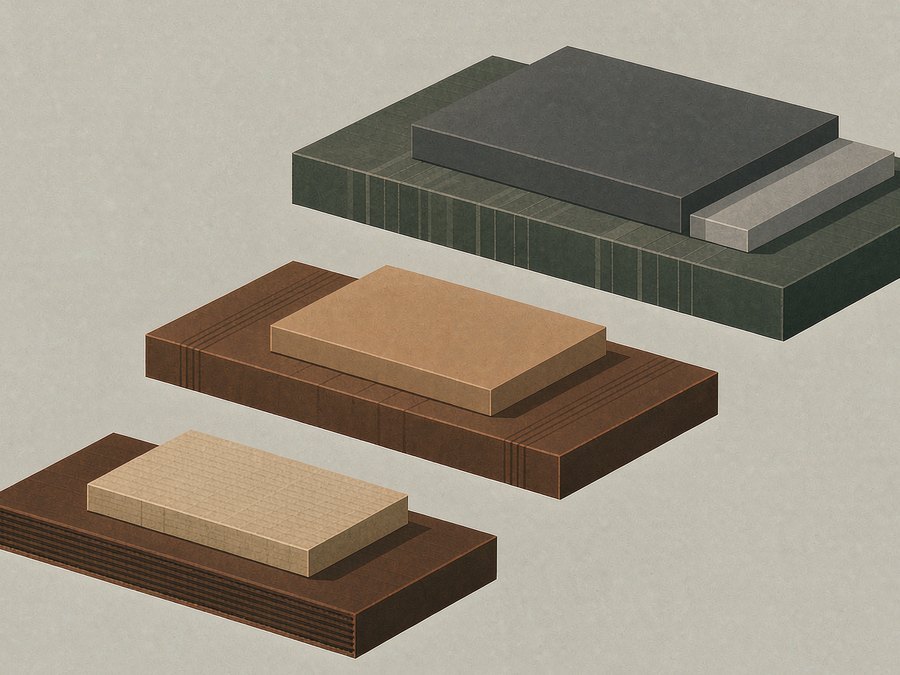
Decide the service life before the finish. The same drawing in a wet chiller aisle and a dry apparel store needs two different materials, even though nothing on the drawing changes.
If the program is uncertain, build the first run in the middle tier. Semi-permanent costs more than board and far less than steel, and it survives a year of normal handling while you find out whether the position deserves a permanent fixture.
The eight-line brief that produces a usable quote
A quotation is only as good as the brief behind it. In our experience eight lines on one page are enough for a factory to quote properly instead of guessing, and every missing line becomes an assumption, which will be the cheapest one available.
- Product. Dimensions, weight, case pack, and the number of facings you want to show.
- Position. Channel, bay width, shelf pitch, shelf depth, and whether the unit stands on the floor, a counter, a shelf or a ceiling grid.
- The one job. Trial, rate of sale, or brand recall. Pick one, because the three produce different designs.
- Life. Weeks, months or years, and whether the unit is refilled or replaced at the end.
- Volume and release. Total quantity, first drop, and whether it is one run or monthly releases against a forecast.
- Brand assets. Logo files, the color standard you are matching to, and the legal copy mandatory in each market.
- Delivery and install. Incoterm, delivery addresses, and who assembles it: store staff, a crew, or the factory before it ships.
- Constraints. Load rating, food contact, fire performance, and any retailer-specific fixture rule.
The line left out most often is life. A supplier who is not told how long the display must last will price the cheapest structure that satisfies the drawing, and that structure will be correct for about one season.
Why POP displays get pulled out of stores
A display rarely disappears because the design was wrong. It disappears because store operations could not live with it, and operations wins that argument every time.
- Assembly takes longer than the store has. Two people and twenty-five minutes means it stays in the back room. One person, under ten minutes, tool-free, is the practical target.
- It arrives damaged. Corner crush is the most common claim we see, and a dented header makes a unit look second-hand before it holds a single product.
- It cannot be restocked. If staff must remove the header to refill, refilling stops. The refill path has to be obvious from the front.
- It blocks the aisle or the sightline. A unit that narrows a walkway below the local egress minimum gets moved, and once moved it is rarely put back.
- Nobody owns it. No planogram position, no reorder point, no refresh date. A display without an owner has a removal date.
The cheapest defence is a small pilot before the roll-out: three stores, one assembly timer, and a restock trial run by the people who will actually do it.
Frequently asked questions
Is a POP display the same as a POS display?
In everyday use, yes: most brands, agencies and factories treat the two as synonyms. The useful distinction is positional rather than semantic, because a unit built for a counter cannot be moved to the floor by making it taller.
How long should a POP display last?
Exactly as long as the program it supports. Seasonal promotions run four to twelve weeks and belong in corrugated or foam board. Brand blocks lasting a year or more justify semi-permanent plastics or a steel frame. Overbuilding is as costly as underbuilding, because the extra durability is paid for in tooling and freight.
What is a realistic first order quantity?
It depends on the tier. A die-cut corrugated run usually becomes economical in the low hundreds. For a tooled plastic or steel unit our own minimum is 100 pieces, and below that the setup cost is spread across too few units to make sense.
Can a POP display ship flat?
Most semi-permanent and permanent units can, and it pays twice: lower chargeable volume on the freight invoice, and less store labor because flat-packed units are assembled where they stand. On flat-pack conversions we have measured packaging volume reductions of up to 60% against the assembled equivalent.
What does a POP display cost?
There is no meaningful single number, because a display price is six cost drivers added together: material, tooling amortization, assembly labor, finishing, packaging and freight. We broke that model down in the true cost of retail displays.
Primary references and further reading
The formats, service tiers and dimensions above come from briefs we have quoted and units we have built on our own lines in Hangzhou since 2011, across metal, acrylic, plastic and wood. Where a figure can be checked independently, such as the density of PMMA or the thickness of a corrugated flute, it is a published physical constant or a standard you can verify. Bay widths and egress rules vary by retailer and market, so measure the store you are actually shipping to.
- Shop! Association, the retail marketing and in-store display industry association, formerly POPAI, for the terminology used in this article.
- ISO 9001, Quality management systems, International Organization for Standardization, the certification our production lines are audited against.
- ASTM D4169, Standard Practice for Performance Testing of Shipping Containers and Systems, for the transit testing referred to above.
- ISTA packaging test protocols, International Safe Transit Association, for drop and vibration validation of display cartons.
Related reading: Product Guides covers specification and installation detail for individual fixture types, and Industry Insights covers sourcing models, material comparisons and cost structure. We hold CE and ISO 9001 certification and are REACH compliant; our plant covers 6,000 square meters with four in-house material lines and a minimum order quantity of 100 pieces.