The True Cost of Retail Displays: Unit Economics from Factory to Shelf | VIGO DISPLAY
The short answer: a retail display has no single "unit price". What you are quoted is six cost drivers added together: material, tooling amortization, assembly labor, finishing, packaging and freight. Each one carries a different weight depending on order volume, part count and how tightly the fixture packs. Two suppliers can price the same drawing three times apart and both be honest, because they are pricing different bills of material. This guide breaks down the cost model we use on our own production lines, driver by driver, so you can read a quote instead of only comparing the bottom line.
In short:
- There is no single unit price. A quote is six cost drivers added together.
- Material is normally 30 to 45 percent of landed unit cost; tooling amortization is the line that moves most with volume.
- Going from 100 to 500 pieces removes four fifths of the tooling burden from each unit. Past a few thousand the curve flattens.
- The most reliable lever is design, not negotiation: fewer parts, tighter nesting, one color.
- A three-year ownership view often reverses the order of a line-by-line quote comparison.
Why the same display gets three different quotes
Two quotes for "the same" display almost never describe the same product. Before price is a meaningful comparison, six variables have to match. When they do not, the gap is not margin. It is scope.
| Variable | What a lower quote usually assumes | What a higher quote usually includes |
|---|---|---|
| Material gauge | 0.8 mm steel, 2 mm acrylic, 12 mm board | 1.2 mm steel, 5 mm acrylic, 18 mm board |
| Tooling ownership | Buyer pays the tool separately, or a stock tool is reused | New tooling amortized into the unit price |
| Finish | Mill finish, one color, no print | Powder coat, UV print, polished edges |
| Packaging | Bulk carton, transit damage accepted | Unit protection, drop tested carton |
| Delivery basis | Ex works, buyer arranges freight | Delivered and cleared to your warehouse |
| Order quantity | 5,000 pcs, released over twelve months | 100 pcs, single production run |
How to normalize two quotes: ask each supplier for the bill of materials, the tooling cost stated separately, the packaging specification, the Incoterm and the production batch size. Same gauge, same finish, same protection, same delivery basis, same quantity. Only then is the difference in price a difference in cost.
Where the money actually goes: six cost drivers
The shares below come from fixtures we have quoted and built on our own lines. Treat them as a shape, not a formula. The point is not the exact percentage. It is that material and freight together usually account for more than half of landed cost, while the two items buyers negotiate hardest, tooling and assembly, are often the smallest.
| Cost driver | Typical share | What moves it most |
|---|---|---|
| 1. Material | 30–45% | Sheet yield, gauge, commodity price of steel, resin, acrylic, board |
| 2. Tooling amortization | 3–15% | Order volume and whether the tool is new or reused |
| 3. Assembly labor | 15–25% | Part count, fastener count, welding versus riveting |
| 4. Finishing | 8–15% | Number of colors, print coverage, polishing steps |
| 5. Packaging | 5–12% | Protection level, nesting efficiency, carton format |
| 6. Freight | 8–20% | Volumetric weight, container fill, delivery basis |
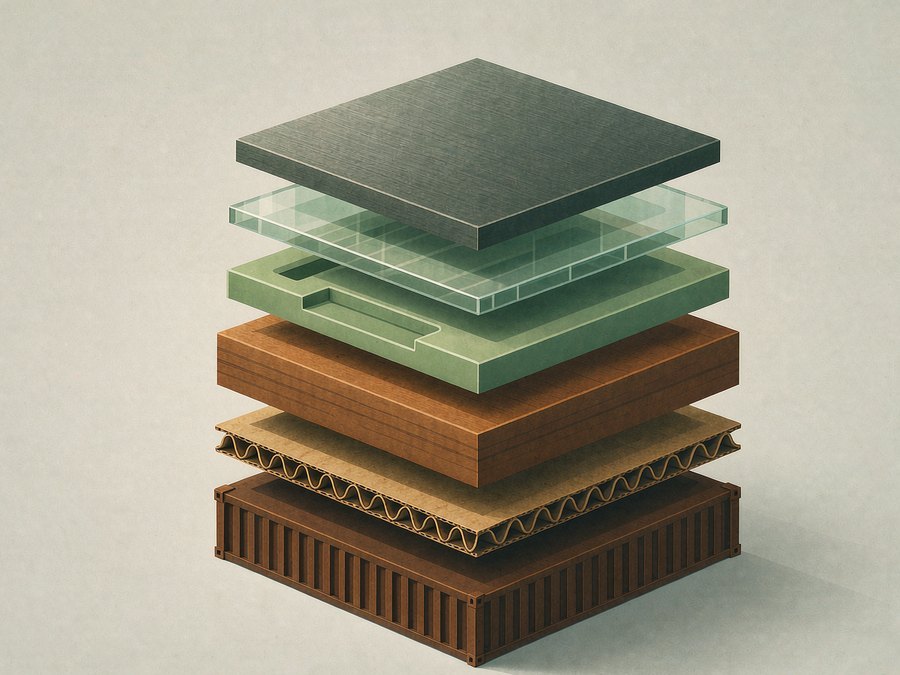
Read the stack from the bottom up. Steel, resin and board are bought by weight or by sheet, so their cost tracks commodity indices you do not control. Assembly and finishing are bought by the hour and by the batch, so their cost tracks how many discrete parts and colors the design needs. Packaging and freight are bought by volume, which is why a design decision made on a screen changes the price of moving the product.
- Material is the largest line and the slowest to negotiate.
- Tooling is the most misunderstood, because it is fixed.
- Freight is the most overlooked, because it is paid last.
- Packaging is the cheapest to redesign and affects both.
1. Material: where the mass goes, the money goes
In most fixtures material is the biggest single line, and it is the one buyers attack first. The usual instruction is to ask for a cheaper material. The better question is how much of the sheet the design actually uses. Material is not only priced per kilogram. It is priced per square meter of sheet, and the offcut is paid for whether it becomes a shelf bracket or scrap.
A standard acrylic sheet is 1,220 by 2,440 mm. A part layout that leaves 15% offcut costs 15% more material than one that nests tightly, before anyone touches the gauge. On one of our acrylic line conversions, changing the nest layout on a shelf divider blank recovered four extra parts per sheet with no design change at all.
Gauge is the second lever, and it compounds. A 5 mm PMMA panel weighs about 5.95 kg per square meter at a density of 1.19 g/cm³. The same panel in 5 mm glass is roughly 12.5 kg. That difference is charged twice, once on the material invoice and again on the freight invoice, because you are now moving a fixture that is more than twice as heavy. Material choice is also a freight decision. For a fuller comparison of how the four common materials behave, see our walkthrough of POP display materials.
2. Tooling: a fixed cost dressed up as a unit cost
Tooling is a one-time cost divided by order quantity, and it is the single biggest reason a 100-piece run and a 10,000-piece run for the same part do not share a unit price. A machined prototype tool, an aluminum production tool and a hardened steel tool can all make the same plastic bracket. They differ in how many shots they survive, how much they cost, and how quickly they come back to the buyer as a line item.
For runs under a few thousand pieces, aluminum is usually the rational choice: cheaper up front, faster to cut, and adequate for the volume. Steel only pays back when you genuinely intend to run hundreds of thousands of shots. Quoting a steel tool into a 500-piece order is one of the most common ways a first order becomes uncompetitive, and it is entirely avoidable if the volume forecast is stated honestly at the briefing stage.
3. Assembly labor: the fastener count problem
Assembly cost scales with part count, not with part size. A counter unit with 22 discrete parts typically takes two to three times the assembly time of a 6-part design of the same footprint, and the difference is almost never visible on a render. It shows up in the box count on the packing list.
This is where design for assembly pays for itself. Every welded joint that becomes a formed tab and every screw that becomes a snap fit removes minutes from every unit in the run. On a 2,000-piece program, ninety seconds saved per unit is 50 hours of direct labor that never gets invoiced.
4. Finishing: color count, coverage and edge quality
Finishing is priced by setup and by coverage. A powder coat is applied at 60 to 100 micrometers over a pretreated surface, and the cost is driven less by the powder itself than by how many color changes the batch requires. One color across a full run is cheap. Three colors across three small sub-batches is not, because each change includes cleaning the booth and re-establishing the film thickness.
On acrylic, the edge treatment is the hidden variable. A laser-cut edge comes out frosted and slightly matte. Flame polishing turns it clear and glass-like in seconds per part. Diamond polishing gives the best finish and costs the most. Where the edge is part of the visual language, this choice alone can move the finishing line by a third.
5. Packaging: the cheapest place to engineer cost out
Packaging usually runs 5 to 12% of landed cost, which is why it gets ignored. That is the wrong way to read it, because packaging also sets the damage rate, and damage is charged at replacement cost plus freight plus the store's labor to process the claim. A carton that saves 40 cents and returns 3% breakage is an expensive carton.
The engineering work happens in three places: how the fixture nests, how the corners are protected, and whether the test standard matches the journey. Our packaging specifications are validated against drop and vibration test protocols rather than judged by eye. On flat-pack conversions we have measured packaging volume reductions of up to 60% against the assembled equivalent, and volume is the input to the next cost driver.
6. Freight: you are paying for air
Freight is priced on chargeable weight, which is whichever is greater: actual weight or volume converted at the carrier's ratio. For retail fixtures, volume almost always wins. A display that ships assembled is mostly air, and the customer pays for the air at the same rate as the steel.
The arithmetic is blunt. A 40-foot high cube holds roughly 65 to 68 cubic meters in practice, a 20-foot container about 33. A display that occupies 0.35 cubic meter assembled and 0.09 cubic meter knocked down does not cut the product cost by 74%, but it cuts the 8 to 20% of landed cost that freight represents, and it usually changes the shipping mode from air to sea as well.
How volume changes the unit price
Unit price falls with volume for one structural reason: fixed costs have more pieces to hide in. Tooling is the obvious one, but setup time, color batches, material minimums and quality inspection all behave the same way. The curve flattens, it does not disappear.
| Order quantity | Tooling per unit | What else changes at this volume |
|---|---|---|
| 100 pcs | 100 | Machined or aluminum tool, manual jigs, batch color, air freight likely |
| 500 pcs | 20 | Dedicated assembly fixture, sea LCL becomes viable |
| 2,000 pcs | 5 | Steel tool starts to pay back, full container loading |
| 10,000 pcs | 1 | Automated assembly cells, annual purchase order, scheduled releases |
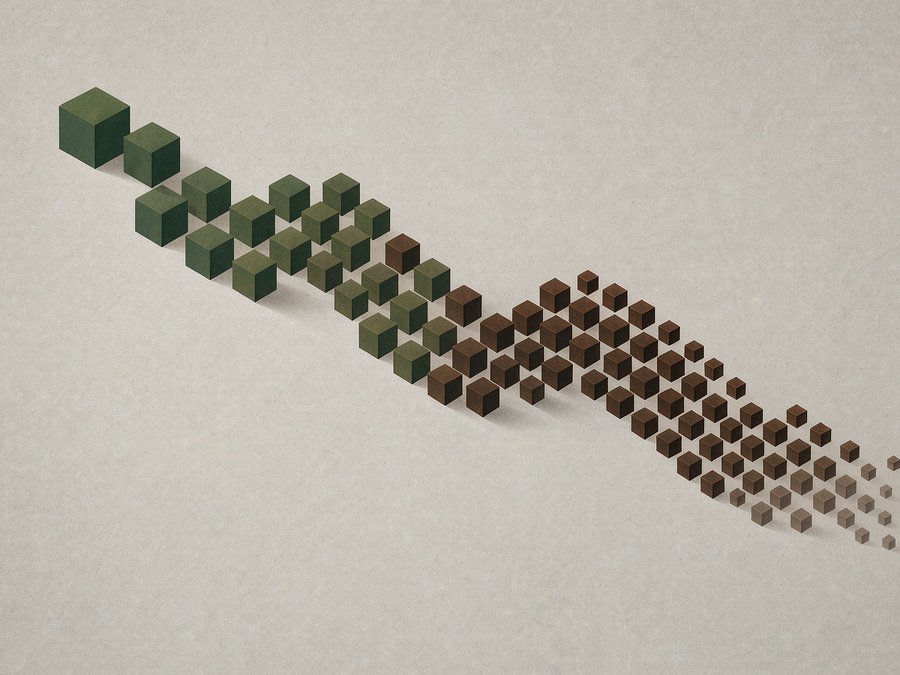
Read the index as a shape. Going from 100 to 500 pieces removes four fifths of the tooling burden from each unit. Going from 2,000 to 10,000 removes four fifths of what is left, which by then is a small number. The second jump feels less dramatic because it is smaller in absolute terms, not because the factory is less willing.
This is also why minimum order quantities exist. Below roughly 100 pieces, setup cost, material minimums and inspection time dominate, and the price per unit climbs faster than most buyers expect.
Why a short run costs more per unit: it is not a penalty. Setup hours, tooling, color batching and material minimums are identical whether you order 100 pieces or 10,000, so at 100 there are simply fewer units to absorb them. If your forecast is genuinely small, ask for a design that avoids new tooling altogether: a formed sheet metal bracket or a cut-and-assembled acrylic part often replaces an injection molded component at low volume.
What the unit price leaves out
A purchase order captures one number. The cost of owning the fixture for three years captures several more, and they are usually larger than the difference between two quotes. Replacement purchases, freight on those replacements, store labor to swap and repair, and disposal all sit outside the quote but inside your budget.
| Line item | Disposable seasonal fixture | Reusable fixture |
|---|---|---|
| Initial purchase | 100 | 158 |
| Replacement purchases over 3 years | 100 | 0 |
| Freight on replacements | 32 | 0 |
| Store labor to swap and repair | 46 | 14 |
| Disposal and waste handling | 18 | 6 |
| Three-year total | 296 | 178 |
The reusable fixture costs 58% more on the purchase order and about 40% less over three years. That inversion is the whole argument for durable fixture design, and it is invisible in a line-by-line quote comparison. The same logic applies to supplier selection: a process that scores only price will systematically select the shortest-lived option.
- Replacement rate is the largest hidden line, and it is a design outcome, not a supplier failure.
- Restocking labor falls when a fixture is designed around the pack, not around the shelf.
- Disposal is increasingly a cost rather than a default in markets with packaging and waste obligations.
What a factory can and cannot flex
Every supplier has room to move on some lines and almost none on others. Knowing which is which turns a price conversation into an engineering conversation, and it usually produces a better outcome than repeated rounds of discount requests.

If a supplier cuts a price without changing anything in the left column of the table below, something in the right column changed without being said. That is the moment to ask which one.
The most reliable way to lower a unit price is not negotiation. It is a design review: fewer parts, tighter nesting, one color, a carton that nests. The manufacturing model you choose also sets how much of that review you get, because an OEM quote prices your drawing while an ODM engagement can change it.
| Usually negotiable | Usually fixed |
|---|---|
| Gauge within a tested range | Compliance and test evidence |
| Finish color and texture | Tooling amortization |
| Packaging format and protection level | Direct labor hours |
| Batch scheduling to fill a container | Commodity material index |
| Payment terms and Incoterm | Ocean and air freight rates |
How this guide was written
Every range in this article comes from quoting and production work carried out on our own lines in Hangzhou between 2011 and 2026, across metal, acrylic, plastic and wood fixtures. The cost shares are expressed as ranges and indices rather than prices, because commodity indices, freight rates and exchange rates move faster than any published table, and a fixed figure would be wrong within a quarter.
No customer case results, no projected savings and no competitor comparisons are used. Where we cite a figure that can be checked independently, such as the density of PMMA or the practical capacity of a 40-foot container, it is a published physical constant or an industry standard. Where we describe a factory practice, it is one we operate.
Scope note: all figures are directional planning ranges, not quotations. A real price depends on your drawing, gauge, finish, packaging, quantity and delivery basis. We hold CE and ISO 9001 certification and are REACH compliant; our plant covers 6,000 square meters with four in-house material lines and a minimum order quantity of 100 pieces.
Frequently asked questions
Why do quotes for the same display differ so much?
Almost always because the bills of material differ. Gauge, finish, tooling ownership, packaging protection, delivery basis and order quantity are the six usual suspects. Ask for each to be stated separately and the spread usually collapses to a normal commercial range.
What share of a display's cost is material?
For most custom fixtures, 30 to 45% of landed unit cost. It runs higher on large flat panels and lower on small, assembly-heavy counter units, where labor takes a bigger share.
Does a higher order quantity always lower the unit price?
It lowers the fixed portion, which is real, but it cannot lower the material index or the freight rate. Past a few thousand pieces the curve flattens, and the remaining gain has to come from design.
Is acrylic cheaper than metal?
Not reliably. Sheet acrylic is often cheaper per square meter than fabricated steel, but it needs thicker sections to reach the same stiffness and its edge finishing adds a step. The honest answer depends on the span and the load, not the material name.
How much does packaging add to the price?
Typically 5 to 12%. The number that matters more is the damage rate it prevents, because a replacement costs the full unit price plus freight plus handling. A 3% breakage rate makes a 40-cent saving a losing trade.
Can I get a price without a drawing?
You can get a range, and a range is genuinely useful at budgeting stage. A firm price needs the overall dimensions, the material, the load it must carry, the finish and the quantity. With those five inputs a factory can quote properly instead of guessing.
Primary references and further reading
- ISO 9001, Quality management systems, International Organization for Standardization.
- ISTA packaging test protocols, International Safe Transit Association, for drop and vibration validation referred to in the packaging section.
- Regulation (EC) No 1935/2004 on materials intended to come into contact with food, relevant to food-adjacent display components.
- 21 CFR Part 177, US Food and Drug Administration, indirect food additives for polymers.
Related reading: Product Guides covers specification and installation detail for individual fixture types, and Industry Insights covers sourcing models and material comparisons.