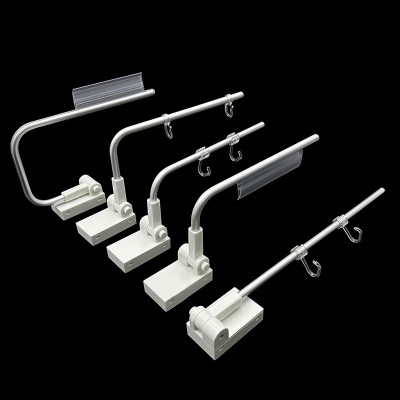
Gravity Roller Shelf System for Canned Drinks: Lane Width, Slope Angle and Loading Rules (JL-25 Guide)

In short: a gravity roller shelf system keeps cans at the front of the shelf with nothing more than a slight downhill slope and a low-friction track. On the JL-25 the track is built from 49 mm ABS roller modules, the length is cut to your shelf, and the tray drops onto the existing panels. Two numbers decide whether it works: lane width = can diameter + 4–6 mm, and a slope of 3° to 6°, with the exact angle depending on can weight and cabinet temperature. Get both right and the lane keeps facing itself. Get either wrong and cans stall, tip, or arrive at the front stop hard enough to dent the lid.
What a gravity roller shelf system does
A gravity roller system does one job: it keeps the front can at the shelf edge without a power supply. Cans sit on parallel roller tracks set slightly downhill toward the aisle. When a shopper takes the front can, the cans behind it roll forward under their own weight and stop against the front bar. There is no spring, no motor, no wiring, and nobody walking the aisle to pull stock forward.
That makes it a different tool from the two it usually gets compared with. Rollers have the lowest friction and the gentlest start. Springs push hardest and work on a flat shelf. Flat glides sit between the two, but how well they work depends heavily on the weight of the pack and the finish of its base.
| Mechanism | Driving force | Typical slope | Works well for | Struggles with |
|---|---|---|---|---|
| Gravity roller track | Can weight on rolling elements | 3°–6° | High-turnover cans and bottles in chilled cabinets | Very light packs; deep lanes need a longer incline |
| Spring pusher | Compressed coil spring | 0° (flat shelf) | Flat shelves holding a mix of shallow and deep product | Uneven push over long lanes; springs lose tension |
| Flat glide / roll-formed track | Can weight on a sliding surface | 5°–12° | Low-cost, lightweight cartons and packs | Wet or frosted cans; stalls in humid cabinets |
How the JL-25 track is built

The JL-25 is a tray rather than a single track. Repeated 49 mm ABS roller modules make up the running surface, wire dividers set the lane width, and a front stop bar keeps the first can upright and facing out. Length is made to order, so the tray follows the real shelf depth instead of leaving a gap behind the front rail.
The 49 mm is easy to misread. It is the width of one roller module. A 66 mm can rests on two adjacent modules, so the figure that goes on a purchase order is the finished lane width, measured from the center of one divider to the center of the next.
- Track body: ABS, black or white, handles cold and condensation.
- Running surface: roller modules, so the can rolls instead of sliding.
- Lane control: wire dividers set the pitch; the front stop sets the presentation line.
- Installation: drops onto existing shelf panels, no rebuild needed.
Step 1: Match the lane width to the can format
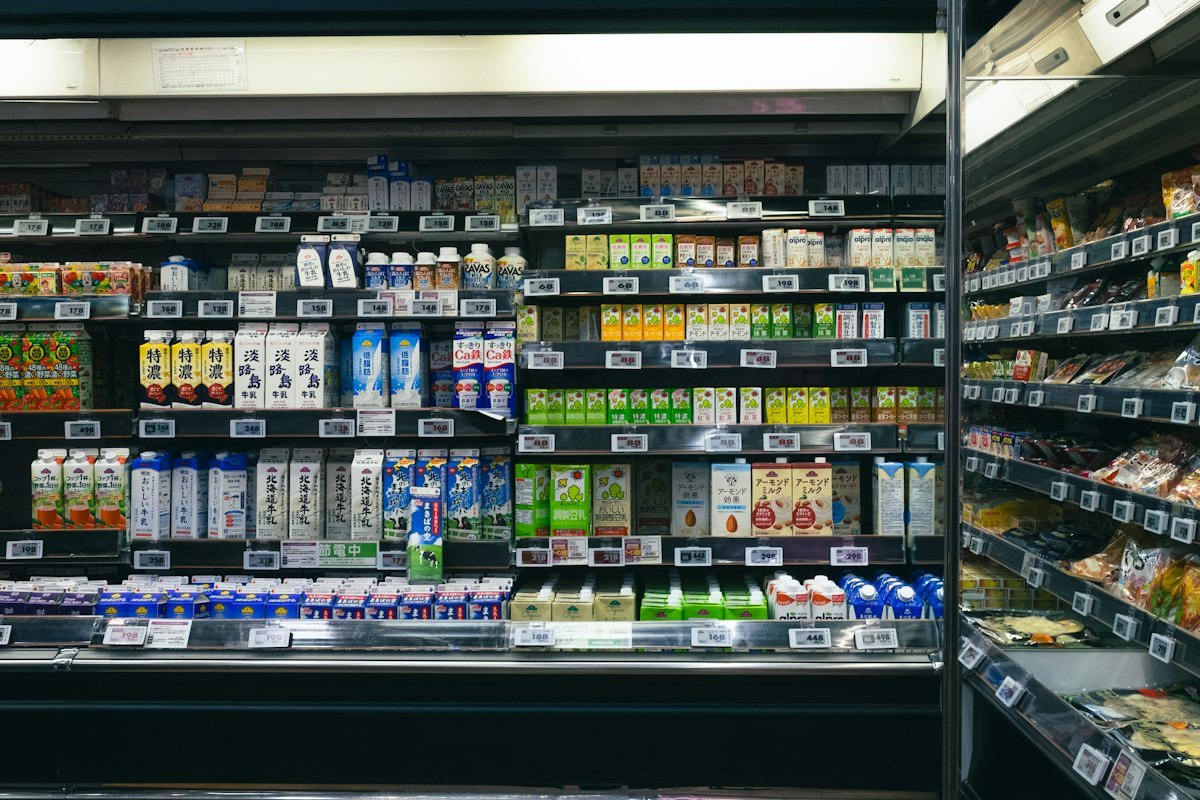
Cans are not one size. A lane set for a 66 mm standard can lets a 53 mm slim can rattle, rotate and jam. Measure the body diameter of every SKU that will run in the lane, then add clearance.
| Format | Body diameter | Height | Recommended lane | What to watch |
|---|---|---|---|---|
| Standard 330 ml | 66.0 mm | 115 mm | 70–72 mm | Baseline format; two 49 mm modules per lane |
| Standard 355 ml (12 oz) | 66.0 mm | 122 mm | 70–72 mm | Check clear height under the shelf above |
| Standard 500 ml | 66.0 mm | 168 mm | 70–72 mm | Tall can: higher front stop, fewer cans per lane |
| Sleek 330 ml | 57.4 mm | 146 mm | 62–64 mm | Narrow and tall, tips easily on a steep lane |
| Slim 250 ml | 53.0 mm | 134 mm | 58–60 mm | Lightest format; test the slope before you commit |
Rule of thumb: lane width = can body diameter + 4 to 6 mm, split evenly on both sides. Under 4 mm of total clearance, the can drags on both dividers and slows down in the cold. Over 6 mm, it starts to skew, and a skewed can shows its label at an angle or wedges across the lane. The diameters above come from published can-making references. Check them against your own filled can before you fix a pitch, because tooling and end profile move height by a millimeter or two.
Step 2: Set the slope, then test it loaded
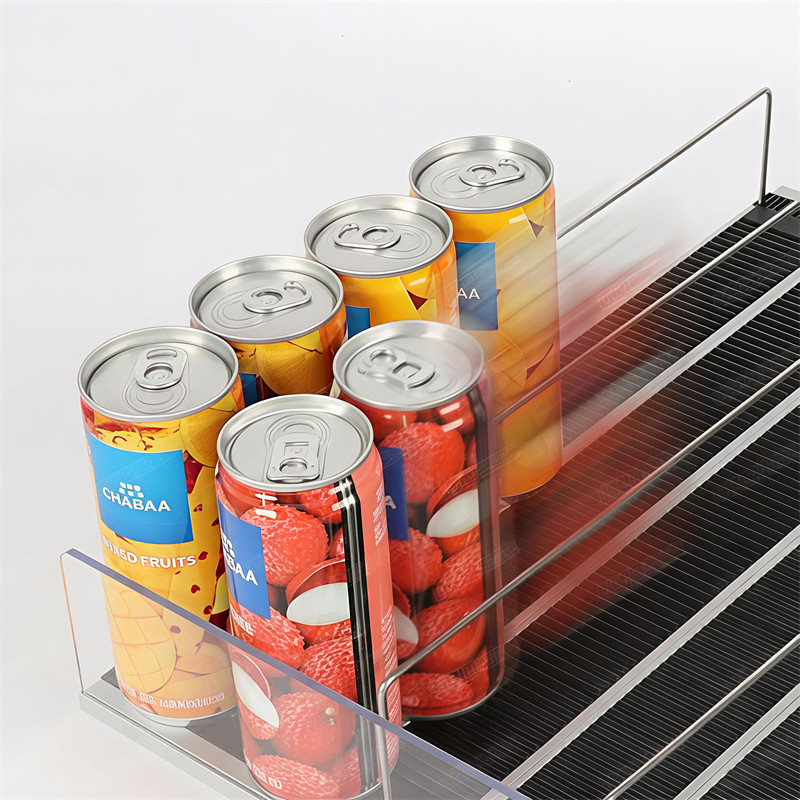
Roller tracks need far less incline than glides because rolling friction is much lower than sliding friction. Gravity roller cabinets usually sit with a slight tilt, most often quoted between 3° and 6°, while cardboard and flat-glide systems are designed well above that. The angle for a particular cabinet depends on can weight, cabinet temperature, and how clean the rollers stay.
| Shelf depth | 3° | 4° | 5° | 6° |
|---|---|---|---|---|
| 400 mm | 21 mm | 28 mm | 35 mm | 42 mm |
| 500 mm | 26 mm | 35 mm | 44 mm | 53 mm |
| 600 mm | 31 mm | 42 mm | 53 mm | 63 mm |
Start low and add angle only if a lane stalls. Too steep is worse than too slow: cans reach the front stop with speed, lids dent, and tall formats tip in the last 100 mm of travel.
- Fill the lane before you judge the slope. A half-empty lane tells you nothing about push force.
- Test warm, then test cold. A lane that runs freely at 20 °C can crawl at 4 °C once condensation and stiffer product are in play.
- Check the shelf left to right. A few millimeters out of level pulls every can against one divider, and the divider bows over a season.
- Look again after 24 hours. New installs settle, and the tray that sat flat on day one may need a shim on day two.
Step 3: Work out lanes and load before you order
Two numbers drive the purchase: how many cans the shelf holds, and whether the frame can carry them. Here is the arithmetic for a cooler shelf 1200 mm wide and 500 mm deep, loaded with standard 330 ml cans.
Load per lane is the figure that matters, not the total. Gravity systems are usually limited by what one lane carries, and 1.4 kg sits well inside working range even for formats twice that weight. The total is where it gets uncomfortable: 23 kg of drinks on a shelf rated for 30 kg leaves very little margin for a customer leaning on the door frame.
Five ways gravity lanes fail
Most complaints about gravity lanes are not product faults. They are four millimeters of clearance or half a degree of slope pointing the wrong way. These five come up again and again in cooler retrofits.
Cans stall halfway down
Usually a dirty roller, a lane that is too shallow, or a can lighter than the lane was set up for. Clean the rollers and add one step of slope before you change any hardware.
Lids dent at the front stop
The lane is too steep for the weight of the can. Cans arrive fast and hit a rigid stop. Take the angle down first. A taller, softer stop is the second fix, not the first.
Cans jam diagonally
The lane is wider than diameter + 6 mm. The can turns, leads with its edge and wedges. Re-set the divider pitch instead of adding another divider.
Slim cans never reach the front
Mixed formats in one lane. A 53 mm can behind a 66 mm can has less mass and less contact with the rollers. Keep one format per lane and split the lanes instead.
Everything drifts to one side
That is cross-level, not slope. Shim the tray until it is level left to right, then check the dividers for bowing after months of one-sided load.
Installation checklist

- Measure the clear shelf, not the nominal one. Depth from front rail to rear wall, width between side supports, and clear height to the shelf above.
- List every SKU and its body diameter. Group the formats and give each group its own lane pitch.
- Work out lane count and depth. Allow for the front stop and a small rear gap inside the clear depth.
- Set the slope with a riser at the back. Start at 3°–4° using the table above.
- Level it left to right before loading. Cross-level matters as much as the incline.
- Load one lane fully and test it. Take the front can out and watch whether the next one travels all the way to the stop.
- Run a cold test. Repeat at cabinet temperature, not in the stockroom.
- Agree a cleaning interval. Clean rollers keep fronting; sticky rollers do not.
Keeping it clean in a cold, humid cabinet
Condensation causes more gravity lane problems than anything else. Every time the door opens, the cabinet swaps cold air for warm, damp air, and sugar from one leaking can dries into a film that stops a roller turning. ABS handles the environment well, but it still needs a routine.
- Lift the tray out and wash it in warm water with a neutral detergent. Solvent cleaners dull and craze ABS.
- Spin every roller by hand once it is dry. If it will not turn under light finger pressure, it will not turn under a can.
- Wipe the shelf panel before refitting. Grit trapped under the tray loads the rollers unevenly.
- Dry it fully before reloading. Water left between modules freezes in freezer cabinets and locks the lane.
JL-25 specifications and ordering
| Item | Specification |
|---|---|
| Model | JL-25 |
| Product type | Gravity roller shelf system / drink dispenser shelf pusher |
| Material | ABS track body with wire dividers and front stop |
| Color | Black / white |
| Track module width | 49 mm per module |
| Length | Customized to your shelf depth |
| Function | Automatic forward feeding, no power supply |
| Application | Refrigerated cabinets, retail display shelves, countertop drink units |
| Minimum order | 100 pcs per model |
| Sample lead time | 7 days |
| Production lead time | 25 days after sample approval |
| FOB port | Shanghai |
| Payment | T/T, PayPal |
| Shipping | Sea freight 20–40 days / air freight 5–10 days / express 3–7 days |
Three details in an inquiry get the quotation right the first time: the clear depth and width of the shelf, the body diameter of each format, and the temperature inside the cabinet. Length is made to order on this product, so a photo or drawing of the existing shelf is worth more than a description.
Frequently asked questions
What slope should a gravity roller shelf be set at?
Start at 3° and go up to 6° only if a lane stalls. Below 3° light cans stop short of the front. Well above 6° heavy cans arrive at the stop fast enough to dent lids and tip tall formats.
Will the JL-25 hold PET bottles as well as cans?
The rollers carry both, but the lane has to be set for the format. PET bottles have a softer base and a different center of gravity, so test them in the lane they will actually run in, at cabinet temperature rather than in the stockroom.
Does it fit an existing refrigerator shelf?
It drops onto existing shelf panels, so nothing has to be rebuilt. What you do need is clear depth, clear width between the side supports, and enough height under the next shelf for the tallest can plus the front stop.
How many cans fit per lane?
Divide the usable depth by the can height. On a 500 mm shelf with standard 330 ml cans that gives three to four cans per lane, or 48 to 64 cans across 16 lanes on a 1200 mm shelf.
Can one lane carry different can sizes?
Not reliably. A 53 mm slim can behind a 66 mm standard can has less mass and less contact with the rollers, so it stalls. Keep one format per lane and split the lanes instead.
What is the minimum order quantity?
100 pcs per model, with custom length included. Samples take 7 days and production runs 25 days from sample approval.
Why buyers specify VIGO DISPLAY
VIGO DISPLAY makes the parts this guide describes: gravity roller tracks, shelf pushers, shelf dividers, back supports and label holders, all in one factory. A gravity lane is three parts working together. When the tray, the dividers and the front stop come from three different suppliers, the 72 mm lane you ordered often measures 74 mm once it is on the shelf. Made to one drawing, the lane comes out at the width you ordered.
What that means when you place an order:
- Length is cut to your shelf depth. The common failure in a retrofit is a tray that stops 40 mm short of the front rail, which costs a can of capacity in every lane for the life of the cabinet.
- Minimum order is 100 pcs per model and samples ship in 7 days, so you can fit one door and run it cold before committing to a store rollout. Production takes 25 days from sample approval.
- Divider pitch is quoted per format. A 66 mm standard can, a 57.4 mm sleek can and a 53 mm slim can each get their own lane width, instead of sharing one that only suits 330 ml.
- Slope is calculated rather than guessed. Give us the cabinet temperature and the shelf depth, and the riser height comes back as a number, because the lane that works at 20 °C often crawls at 4 °C.
If you are still deciding between mechanisms, three other guides cover the rest of the shelf: shelf pusher systems in practice, dividers versus pushers, and back support types and installation.
Send us your shelf dimensions
Tell us the clear depth and width of the shelf, the body diameter of every can you plan to run, and the temperature inside the cabinet. We will send back a lane count, a divider pitch for each format, a riser height for your slope, and a quotation. A photo or drawing of the existing shelf saves a round of back and forth.
If you would rather read the specifications first, they are on the JL-25 gravity roller shelf system product page.