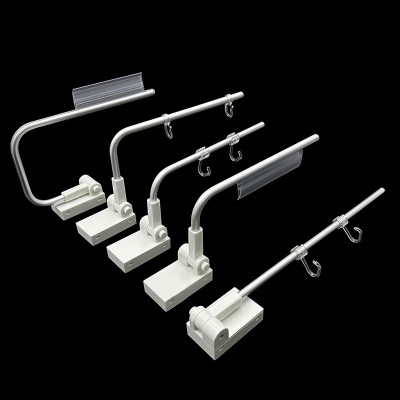
Shelf Pusher Back Supports: Types, Specs and the Installation Rules That Keep Stock Fronted
A shelf pusher back support is the part at the rear of a lane that holds the last pack upright and stops a row of stock sliding backwards off the shelf. It is the cheapest component in a self-facing lane and the one that decides whether that lane still looks fronted at eight in the evening.
Two different jobs hide under the same name. Some back supports are rear stops for a pusher lane: they anchor the rear end of the track and take the reaction force of a spring or a gravity slope. Others are free-standing rear supports, used on shelves with no pusher at all, where they simply stand the final pack up so the row behind it cannot collapse. Confusing the two is the most common reason a back support order arrives, gets fitted, and then does not hold.
This guide is written for buyers, category managers and fixture engineers who have to commit to a rear-support specification before the planogram is frozen. It covers the six back-support types sold today, the order in which the specification should be decided, the material trade-offs behind PP, PS, ABS, PET and acrylic, the installation rules that prevent rework, the failure modes we see in live stores, and the full VIGO DISPLAY model range with sizes and prices-relevant order terms. Every dimension quoted comes from our current catalogue; rules of thumb are labelled as such.

What a Back Support Actually Does
A back support holds the rear of a row in position. That single function shows up as four measurable jobs on the shelf, and it is worth checking a candidate product against all four before ordering:
The four jobs of a rear support
- Holds the last pack upright. On a deep shelf the rearmost pack has nothing behind it. Bagged goods slump, boxed goods lean, and the whole row tilts backwards into the wasted depth.
- Stops backward travel. Each pull by a shopper nudges the row back a few millimetres. Without a rear stop the row creeps until the front of the lane is empty and the stock is invisible.
- Anchors the pusher. Where a spring or gravity pusher is used, the rear stop is the reaction point. If it moves, the pusher loses preload and the lane stops self-facing.
- Protects the lane geometry. A fixed rear reference keeps the planogram depth consistent from bay to bay, so planogram resets take minutes instead of hours.
A back support is not a pusher and does not replace one. A pusher is the moving element that follows the stock forward; a back support is the fixed element that the stock and the pusher push against. Lanes that already use a good spring pusher with an integrated rear stop usually need no separate back support at all. Lanes without a pusher, and lanes on deep shelving, almost always do.
Anatomy of a Self-Facing Lane
Rear-support specification only makes sense against the whole lane, so start with the parts that surround it. The diagram below is a side view of a spring pusher lane on a gondola shelf.
1 back support (rear stop) · 2 goods row · 3 spring pusher · 4 pusher anchor / track end · 5 shelf-edge front stop.
The important dimension is the gap between part 1 and part 4. A rear stop has to sit behind the pusher's rearmost travel, otherwise the pusher bottoms out against the stop before the lane is empty and the last few facings never come forward. That single measurement causes more misfits than material choice does.
The Six Back Support Types Sold Today
Almost every rear support on the market is one of six types. The mounting method, not the shape, is what separates them, and the mounting method is decided by the shelf underneath.
| Type | Mounting | Relocatable | Best for | Watch out for |
|---|---|---|---|---|
| Magnetic back support | Magnet base on a ferrous shelf | Yes, by hand | Fast planogram changes, mixed depths on one shelf, no-tool retrofits | Will not hold on aluminium, glass, timber or plastic shelves |
| Foldable magnetic back support | Magnet base, hinged foot | Yes, by hand | Mixed pack sizes, tall narrow cartons, shelves where the rear line moves weekly | Hinge is the wear point; check the fold action on the sample |
| Track-clip pusher back plate | Clips onto a breakable or modular pusher track | Yes, with the track | Pusher lanes where the rear stop must stay square to the track | Must match track profile and pitch, and fit behind the pusher's travel |
| Fixed rear fence or bolted back stop | Screws or bolts to the shelf or to the fixture upright | No | Heavy packs, permanent bays, warehouse-style pick faces | Requires drilling; a planogram change becomes a maintenance job |
| Adhesive back plate | Double-sided tape or an adhesive steel plate | Limited | Non-ferrous shelves, glass shelves, acrylic and timber displays | Adhesion depends on surface energy and cleaning; expect a shorter service life |
| Integrated track end cap | Moulded into the pusher track | No | High-volume rollouts where the track and stop are bought as one unit | Fixed height and depth, so one SKU change can invalidate the lane |
The first three types cover the overwhelming majority of retrofit work. The last three are usually specified at fixture-build stage.

The two designs most often compared are the magnetic stand and the track-clip plate. They solve the same problem through different mechanics, so it helps to see them side by side.
A is repositioned by hand and depends on a clean ferrous surface. B is locked to the track pitch, so it cannot drift sideways but must match the track exactly.
Five Decisions, In This Order
Rear supports are usually bought by size, and size is the wrong first question. Work through these five decisions in sequence and the model picks itself.
- 1The shelf material. Hold a magnet against the shelf. If it grips, a magnetic base is available to you; if it does not, you are choosing between a clip-on plate, an adhesive plate and a bolted stop. Powder-coated steel still grips. Aluminium, stainless steel of the non-magnetic grades, glass, acrylic and timber do not.
- 2The pack. Height, depth, weight and where the centre of gravity sits decide how much support wall you need. A tall narrow carton needs a taller plate than a squat bag of the same weight, because it topples rather than slides.
- 3The lane depth and whether a track exists. With a pusher track present, the rear stop must match the track profile and sit behind the pusher's rearmost travel. Without a track, the rear line is free, which is where magnetic stands win.
- 4The restocking routine. Bays that are reset weekly reward hand-movable supports. Bays set once a season are better served by a fixed or clip-on stop that cannot be knocked out of position.
- 5Visibility and cleaning. Clear supports keep the shelf looking empty at the back, which customers read as low stock; opaque white hides the mechanism. Clear also shows scratches, and acrylic is affected by alcohol-based sanitiser.
PS, PP, ABS, PET or Acrylic
All five polymers appear in this product category, and the difference is visible on the shelf within a season. The table below is the short version we use when a buyer asks why two supports that look identical differ in price.
| Material | Clarity | Stiffness | Impact and fatigue | Cold store | Typical role |
|---|---|---|---|---|---|
| PP | Semi-transparent, slightly milky | Medium | Good fatigue life, flexes instead of cracking | Good | Foldable supports and long track plates where a hinge or clip flexes thousands of times |
| PS | High clarity, glass-like | High | Brittle; sharp impact can craze or crack | Poor | Tall clear supports on ambient shelves where the look matters |
| ABS | Opaque only | High | Tough, absorbs impact well | Moderate | White supports that must hide scratches and survive rough handling |
| PET | Clear, good gloss | Medium-high | Better impact than PS, less than ABS | Moderate | Small clear supports where clarity and toughness both matter |
| Acrylic (PMMA) | Best optical clarity | High | Stiff but notch-sensitive; crazes under solvent attack | Moderate | Premium clear supports in display-grade retail and pharmacy |
Cold-store note: impact strength falls as temperature drops, and PS and acrylic lose it fastest. For chillers and freezer aisles specify PP or PET.
Two details on the magnetic base are worth asking about before you approve a sample. The first is holding force per unit area, which drops sharply with paint thickness and with any gap between magnet and steel; a rubber overmould costs nothing in holding force but protects the shelf coating and stops the support skating. The second is magnet grade and coating, because a plated magnet in a wash-down or humid chiller will corrode and stain the shelf if the housing is not sealed.

Installation Rules That Prevent Rework
A rear support that is fitted badly behaves like a support of the wrong size, and the complaint that follows is always about the product. These seven steps are what we ask installers to follow on a rollout.
- 1Test the shelf with a magnet. Do it on the actual shelf, not on the neighbouring bay. Shelf decks are often a different steel grade from the uprights.
- 2Clean the contact patch. Dust and label residue cut holding force more than paint thickness does.
- 3Mark the rear line. Tape it at shelf depth minus pack depth, then subtract another 10 to 15 mm for the support wall itself.
- 4Check for obstructions. Shelf lips, welded steps, rivets and perforations all stop a base sitting flat. An unflat base is a base that slides.
- 5Fit behind the pusher's travel. With a pusher lane, cycle the pusher to its rearmost point and confirm clearance before locking anything down.
- 6Load to full and cycle twenty times. Push the row back with the flat of your hand, twenty times, and watch for creep and lift-off. This takes under a minute and catches most bad fits.
- 7Record the position. Photograph the bay and note the measurement. The next planogram reset then takes minutes, and a replacement order can be placed from the photo.
Skip these three things: do not fit a magnetic support onto a shelf that has just been cleaned with a silicone-based polish, do not force a track clip onto a track pitch it was not moulded for, and do not fit rigid plastic parts straight out of a cold delivery vehicle in winter. Cold parts crack; let them reach room temperature first.
Where Back Supports Fail in Live Stores
These are the six complaints that reach us most often, with the cause and the fix. In most cases the product is doing what it was specified to do, and the specification was the problem.
| Symptom | Likely cause | Fix |
|---|---|---|
| Support creeps backwards under load | Holding force too low for the paint build-up, or a base that does not sit flat | Move to a flat patch, add an adhesive steel plate, or switch to a track-clip type |
| Support tips forward when the lane is pushed | Base too short for the wall height, so the push lands outside the footprint | Choose a longer base or a fold-out foot; add a front stop to the lane |
| Tall light packs fall over the top edge | Support wall below one-third of pack height | Step up to the tallest size in the range, and check the pack's centre of gravity |
| Clip cracks on a breakable track | Track pitch mismatch, or cold parts forced into place | Verify pitch against the sample, warm the parts before fitting |
| Clear support goes foggy or crazes | Alcohol or ammonia cleaner attacking acrylic | Switch the material to PP or PET, or change the cleaning chemical in that aisle |
| Lane looks unfronted at close of day | Rear line set too far back, or pusher preload lost because the stop moved | Reset the rear line to shelf depth minus pack depth, then re-check the pusher travel |
One pattern is worth naming. The failures that look like product faults are usually depth faults: the support was ordered to fit the shelf, not to fit the pack. A 500 mm shelf holding 300 mm packs does not need a 500 mm support, and fitting one guarantees that the rearmost 200 mm never comes forward.
Specification Sheet: The VIGO DISPLAY Range
Our own range covers both mechanics described above: eight magnetic stand-alone supports across four material families, and one track-clip pusher back plate. All models are supplied clear or semi-transparent unless noted, and all magnetic models are intended for flat ferrous gondola and iron shelving.
| Model | Material | Colour | Size (mm) | Mounting | Typical use |
|---|---|---|---|---|---|
| JL-51A | Acrylic + magnetic base | Clear | L110 × W70 × H120 | Magnetic | General clear support for boxed and bagged goods |
| JL-51B | PET + magnetic base | Clear | L80 × W45 × H100 | Magnetic | Narrow lanes, small bagged goods, confectionery |
| JL-51C | Acrylic + magnetic base | Clear | L110 × W70 × H120 | Magnetic | Same footprint as JL-51A; confirm the current version with sales before specifying both |
| JL-52 | ABS + magnetic base | White | L100 × W45 × H110 | Magnetic | Opaque support that hides shelf marks and scratches |
| JL-53A | PP + magnetic base | Semi-transparent | L75 × W75 × H130 | Magnetic, foldable | Tall narrow packs; hinged backing adjusts the wall angle |
| JL-53B | PP + magnetic base | Semi-transparent | 125 × 40 × 100 / 160 × 100 × 120 / 175 × 150 × 153 | Magnetic, foldable | Widest size coverage in the range; three stock sizes for mixed pack heights |
| JL-54A | Plastic + magnetic base | Clear | 112 × 64 × 102 / 134 × 91 × 132 | Magnetic | Two sizes for medium boxed goods on gondola shelving |
| JL-54B | PS + magnetic base | Clear | L132 × W90 × H150 | Magnetic | Tallest support wall in the range, for tall boxed packs |
| JL-55 | PP | Clear | L385–485 × W55 | Clips to breakable track | Pusher back plate for breakable track lanes; rear stop stays square to the track |
Sizes are as published for the current catalogue. Confirm the track profile and pitch before ordering JL-55 against a third-party track. Full listings and photographs are on the Merchandise Shelf Pushers page.
Order Terms, MOQ and Lead Time
Rear supports are a low-value, high-count item, so order terms matter as much as the part. These are our standard terms; they apply to catalogue models and to logo or structural customisation alike, with tooling quoted separately where a new mould is needed.
| Item | Standard |
|---|---|
| Minimum order quantity | 100 pcs per model, including logo and structural customisation |
| Sample lead time | 7 days |
| Production lead time | 25 days after sample approval |
| Tooling | Quoted separately when a new mould or structural change is required |
| Shipping | Sea 20–40 days, air 5–10 days, express 3–7 days |
To quote quickly we need six things from you: shelf material and thickness, pack height, depth and weight, shelf depth, a photograph of the existing lane or track, the pack sample or its artwork, and the target quantity per model. With those, a rear-support recommendation is usually a one-page answer rather than a sample round.
Who prepares this guide
VIGO DISPLAY designs and moulds retail shelf fittings and display hardware in Hangzhou and supplies importers, distributors and chain-store fixture buyers worldwide. This article is maintained by our merchandising hardware team and reviewed against the current catalogue; the specification table above is generated from live product data rather than from marketing copy.
Ten Checks Before You Approve a Bulk Order
Ten checks, one gate: the sample moves from the bench to the shelf, and only a full set of passes releases the repeat order.
- 1Measure the sample against the drawing, not against the photo, and record width, height and base depth.
- 2Stand it on a real shelf sample and confirm the base sits flat with no rock.
- 3Test the magnet on the actual shelf, loaded, then push the row back ten times.
- 4Load the heaviest pack in the range and check that nothing deflects at the wall.
- 5Cycle a foldable model fifty times and listen for the hinge.
- 6Check the clip against the track: it should seat by hand, with no force and no wobble.
- 7Confirm edge finish and that there is no flash on the contact faces.
- 8Check clarity against a reference part if the shelf is premium retail.
- 9Confirm packing quantity and carton drop protection for the shipment mode.
- 10Keep one signed sample and one photograph per model with the purchase order.
Frequently Asked Questions
Do magnetic back supports work on every supermarket shelf?
No. They work on ferrous steel, including powder-coated and painted decks, and they fail on aluminium, non-magnetic stainless steel, glass, acrylic and timber. Test the actual shelf deck with a magnet before ordering; a shelf that grips at the upright can still be non-ferrous at the deck.
Back support or pusher: which do I need?
If the lane already has a spring or gravity pusher with an intact rear stop, you need neither. If the lane has no pusher and the rear pack collapses, add a back support. If stock sits back and never comes forward, that is a pusher problem, and a back support will only fix the symptom at the rear of the row.
What size support does a 400 mm deep shelf need?
Size it to the pack, not to the shelf. Set the rear line at shelf depth minus pack depth, so a 400 mm shelf holding 250 mm packs gives roughly 150 mm of working space, and the support wall itself takes 10 to 15 mm of that. Choose the shallowest base that still clears the pusher and covers one-third to one-half of the pack height.
Can I retrofit a back plate to an existing pusher track?
Usually yes, if the track is a breakable or modular type and the profile matches. Measure the pitch between track segments, the track width and the height of the side rails, and send a photograph with a ruler in frame. JL-55 style plates are length-adjustable across 385 to 485 mm, which covers most breakable track runs, but the clip geometry has to match.
Can the supports be branded or made in our colour?
Yes, from 100 pcs per model. Logo printing and structural changes share the same minimum order; a new mould or a structural modification is quoted separately. Colour matching to a Pantone reference is possible on opaque materials such as ABS, and on PP and PS by batch.
Send Us the Lane, Not Just the Part Number
The fastest way to get a rear-support specification right is to photograph the lane with a ruler in frame, note the shelf material and pack dimensions, and send it with the target quantity. We will come back with a model and a size rather than a list of options.
Browse the Merchandise Shelf Pushers range or send your lane details to our merchandising hardware team for a sample request. Samples take 7 days, production 25 days after approval, and the minimum is 100 pcs per model.
Last reviewed: 26 October 2026 · Published by the VIGO DISPLAY merchandising hardware team, Hangzhou