China vs Local Display Manufacturing: A Total Cost Analysis | VIGO DISPLAY
In short
- Landed cost has six lines. Only one of them is the price you negotiated, and it is usually the smallest source of error.
- US duty is charged on the FOB value, not the CIF value. Freight is not dutiable — but the mold you supply for free probably is.
- The tariff on metal display fixtures is often zero at MFN. The cost sits in the Chapter 99 overlay, which changes with policy, not with your negotiation.
- Freight is a cube problem. Knock-down packing usually saves more than a rate negotiation, and it is decided at the drawing stage.
- At 1,000 units the arithmetic rarely flips to domestic. At 200 units, or with a 45% overlay, it often does.
Every display program eventually gets compared against a domestic quote, and the comparison usually collapses into two numbers: the FOB price from Asia and the delivered price from a local fabricator. Those two numbers are not the same kind of number. One is a factory gate price with six costs still to come; the other already contains labor, freight, overhead and margin. Approving a program by comparing them directly is how a budget gets signed in March and blown in the second quarter. What follows is the six-line model we use when a buyer asks us to defend our own price against a local one.
Six lines, and only one of them is a price
A landed cost is not a single number with a margin on top. It is six lines, each with a different owner inside your company, which is exactly why nobody assembles all six until something goes wrong.
The first line is the factory price. The second is getting the goods across the water. The third is what the government charges to let them in. The fourth is moving them from the port to a shelf-ready position in your warehouse. The fifth is the money you have tied up while all of that happens. The sixth is the expected cost of the things that go wrong often enough to budget for: rework, chargebacks, and the occasional air shipment you did not plan.
| Line | What it contains | Where the number comes from | Typical size |
|---|---|---|---|
| 1. Factory price | The FOB unit price, plus any tooling, plus packaging | Your PO. This is the only line a supplier controls outright | 55–65% of landed |
| 2. Main carriage | Ocean or air freight, marine insurance, origin charges | Weekly spot indices, or a contract rate your forwarder holds | 8–25% of landed |
| 3. Duty and fees | MFN rate, Chapter 99 overlays, MPF, HMF | The HTS classification and the measures in force on the entry date | 0–45% of FOB |
| 4. Port to rack | Terminal handling, drayage, devanning, receiving, put-away | Your 3PL rate card, per container and per pallet | 3–7% of landed |
| 5. Capital | Deposit at PO, goods in transit, safety stock, slow-moving inventory | Your cost of capital and the length of the pipeline | 0.5–3% of landed |
| 6. Risk | Rework, damage in transit, chargebacks, expediting | Your last three programs. If you have none, use a range | 1–6% of landed |
The ranges are wide on purpose. Line 2 in particular has moved more in the past eighteen months than in the previous ten years, and any article that gives you a single freight number is telling you about the week it was written, not about your shipment.
The duty is charged on a different number than most buyers assume
Start with valuation, because it decides the size of line 3 and almost nobody checks it.
US Customs appraises imported merchandise at transaction value: the price actually paid or payable for the goods, exclusive of the costs of international freight, insurance and related services. That is not an interpretation; it is the definition, and the regulations walk through it with a worked example in which a $150 ocean freight and insurance charge is excluded from the dutiable value of a $2,000 shipment. So your duty base is the FOB price, not the CIF price you may be used to from other markets.
Two consequences follow, and they point in opposite directions.
Good news: freight is not dutiable. If you pay $17 of freight per unit, you do not pay 25% duty on that $17. Freight and duty are therefore independent levers, and a dollar saved on one is a dollar saved — not a dollar and a quarter.
Bad news: the things you give the factory for free are dutiable, and they can be large. If you supply tooling, molds, dies, or engineering at no charge or at reduced cost, those are assists. Their value has to be apportioned and added to the entered value of the merchandise they helped produce. A $38,000 injection mold is not a one-line capital expense on your books; it is $38,000 of extra dutiable value, spread across the units it makes.
That produces the trap that catches first-time buyers on low volumes:
Run the arithmetic before you choose a volume. A $38,000 mold amortized over 5,000 units adds $7.60 to each unit's entered value. The same mold amortized over 200 units adds $190. On a product with a $48 FOB price, that turns a 25% overlay into 25% of $238 — about $59.50 of duty per unit, more than the product's own price. Volume is not a purchasing decision you make after the tooling; it is the thing that decides whether the tooling was affordable.

There is a legitimate way around it, and it has a cost of its own: let the supplier own and amortize the tool into the unit price, and no assist exists. You pay for the amortization inside the price, you avoid the duty on the tool, and you give up control of the tool. If the relationship ends, the mold stays where it is. Buyers who intend to move production later should keep ownership and accept the assist treatment; buyers running one program should usually let the supplier carry it.
The overlay is the number that moves
Here is the part that surprises finance teams who already know about tariffs. For the most common display fixture classifications, the statutory duty is often zero. Metal furniture and fixtures under HTS 9403.20.00 carry a general rate of Free; the same is true of several wooden fixture lines under 9403.30 and 9403.60. So when someone says "the tariff is 25%", they are not describing the HTS rate. They are describing an overlay in Chapter 99 that sits on top of it.
That distinction matters because the two numbers behave differently. The HTS rate is stable for years and is a classification question. The Chapter 99 overlay is a policy instrument, revised by notice, sometimes at short notice, and it is the only part of your duty bill that can change between two orders of the same product.
For Chinese-origin goods, the largest overlay has been the Section 301 action, at 25% on a long list of classifications since 2018. It has not expired. USTR opened the second statutory four-year review on 6 May 2026, received requests for continuation, and on 7 October 2026 published a notice confirming that the actions did not terminate and remain in effect while the review proceeds. That notice does not change any rate by itself; a change would require a later, separate action.
On top of that, additional measures introduced and amended through 2025 and 2026 have made the total stack on a given entry genuinely time-sensitive. Two identical containers, entered a quarter apart, can carry different total duty. This is not a reason to avoid the exercise. It is a reason to model duty as an input rather than a constant.
Three practical rules follow:
- Get the classification right before you get the rate. A display that ships as furniture, as a plastics article, or as a printed paper product can land in three different chapters with three different overlays. A binding ruling is slow; a written classification opinion from a licensed broker is fast and is enough for planning.
- Ask for the rate for your entry date, in writing. Not the rate today, and not a percentage quoted in a sales deck from last year.
- Check AD/CVD scope separately. Certain boltless steel shelving and steel racks from China are covered by anti-dumping and countervailing orders. Whether your item falls inside a scope is decided by product description and the Department of Commerce, not by your broker's best guess. If you are quoting a steel rack, this is the first question, not the last.
Freight is a cube problem, not a weight problem
Display fixtures are light for their size. A four-tier floor unit might weigh 17 kg and fill a third of a cubic meter in its carton. A 40 ft high-cube container will take about 26 tonnes of payload and roughly 76 cubic meters of internal volume, of which 60 to 64 are realistically usable once you account for pallets, load patterns and door clearance. You run out of volume long before you run out of weight, every time.
That single fact reorganizes the freight line. Your cost per unit is not the rate; it is the rate divided by the number of units you can fit, and the number of units you can fit is a design decision.
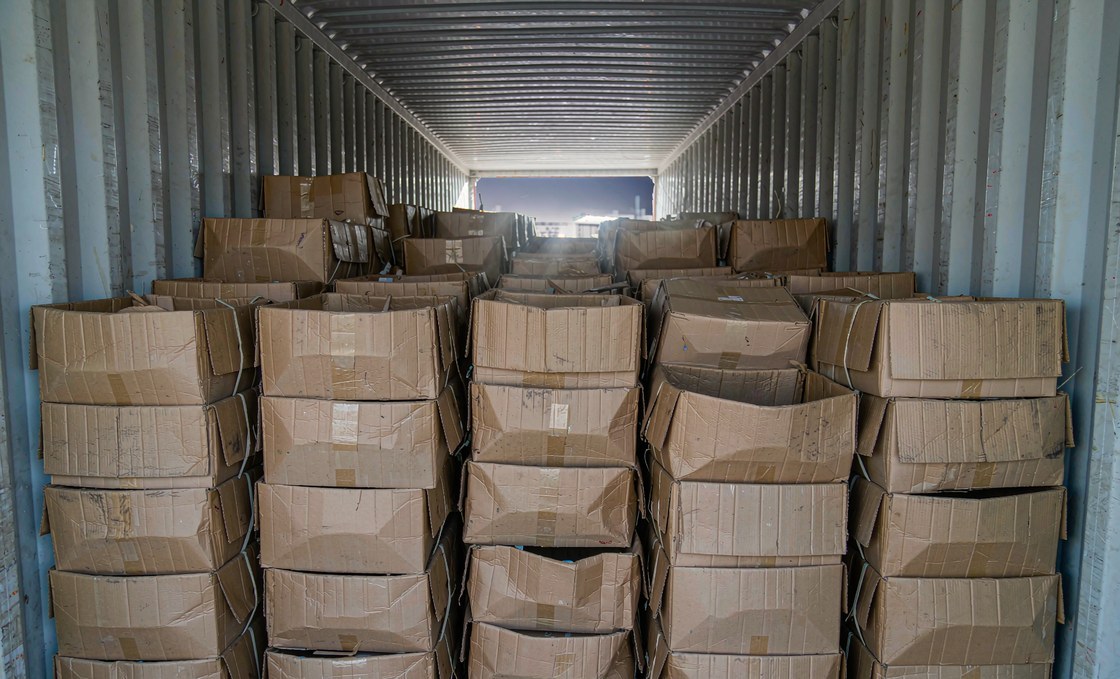
As of the week of 29 October 2026, Drewry's World Container Index put Shanghai–Los Angeles at $7,514 per 40 ft container and Shanghai–New York at $9,631, with the composite index at $4,429. The Los Angeles figure fell 6% within that single week. Do not carry them into a budget as if they were stable. Do use them to see the shape of the problem.
| Packing state | Cube per unit | Units per 40 ft HC | Freight per unit |
|---|---|---|---|
| Assembled | 0.81 m³ | 76 | $98.87 |
| Partly knocked down | 0.34 m³ | 182 | $41.29 |
| Full knock-down | 0.14 m³ | 440 | $17.08 |
Read that table again before you read the rest of this section. The difference between shipping a display assembled and shipping it flat is $81 per unit at today's spot rate — larger than most buyers' entire negotiated margin, and larger than the labor cost difference the decision was supposed to be about.
This is why knock-down design matters more than rate negotiation. A 30% reduction in packed cube beats a 30% reduction in the freight rate, because the rate applies to a container that now holds more product, and because the saving compounds across every shipment rather than only the ones you happen to renegotiate.
Two cautions. First, knock-down moves assembly labor to the destination: someone has to build 440 units before they go on the floor, and that labor belongs in the comparison or the saving is fictional. Second, a tighter pack loads higher and heavier per carton; if the carton is specified for three-high stacking and the container is loaded six-high, the damage that follows will be booked as a quality problem when it was a packing-specification problem.
Lead time is a cash line, and a decision-lag line
Door to door, a Chinese fixture program typically runs 10 to 14 weeks in a normal cycle: two weeks of booking and documentation, production of four to six weeks, a sailing of 12 to 18 days from Shanghai to the US West Coast, and about two weeks of customs, drayage and receiving. East Coast all-water routing through Panama adds roughly two weeks to the sailing alone.
The pure carrying cost of that pipeline is smaller than most people expect. At a 9% cost of capital, an extra twelve weeks of pipeline on an $82 landed unit is about $1.70 — under 2% of the unit cost. If that were the whole story, lead time would not be worth a paragraph.
The real cost is that you commit 14 weeks before you learn. A planogram change, a retailer's rebrand, a packaging revision — any of these arriving after the PO is cut becomes either scrap or a rework invoice. Domestic supply does not remove that risk, but it compresses the exposure window from fourteen weeks to four, and that is a financial property of the supply chain, not a preference.
So the honest way to book this line is not "capital cost of inventory" but "cost of being wrong plus capital cost of inventory". If your display design is stable and your forecasts are good, that second term approaches zero and the line is genuinely small. If you are launching a new brand identity, it is the biggest line in the model.
MOQ turns a price into a position
A minimum order quantity is not a constraint on your order. It is a constraint on your ability to change your mind.
A domestic fabricator quoting 50 units lets you run a pilot in twenty stores, find out that the header is too tall, and fix it in the next order. An overseas program at 1,320 units may represent three seasons of a fixture you will revise twice. The cost of that rigidity is quantifiable and almost never in the spreadsheet: multiply the units you expect to be superseded by the unit cost, and add the markdown or the scrap value.
If you expect 15% of a 1,320-unit program to be obsolete before it is installed, that is 198 units — at a landed cost near $82, about $16,000, or 15% of the program. Compare that with the price gap you were negotiating over. In our experience the gap is usually smaller than the obsolescence.
Price the risk instead of arguing about it
Delay and quality are not abstractions and they are not insults to your supplier. They are lines with an expected value, and expected value is computable even when it is uncertain.
Take one event: the container misses the install date and you air-freight a partial recovery. Suppose that costs $9,000 and has a 20% chance on a program of this size. The expected cost is $1,800, or $1.36 per unit. That is a number you can put in a cell and defend. Replacing it with "we don't want to risk it" is not a financial argument, and it will lose to a cheaper quote every time.
Do the same for rework: if 4% of units need touch-up at $7 each, that is $0.28 per unit. Do the same for damage in transit, chargebacks for a late advance ship notice, and the cost of a second quality inspection trip. Four small lines, each defensible, and together they usually add 2% to 5% to the landed cost — not enough to change a decision on its own, which is precisely why they should be in the model rather than in the argument.
A worked example, with the assumptions on the table
Here is a program sized for a 100-store rollout: 1,320 units of a four-tier floor display, packed full knock-down at 0.14 m³ and 17 kg per carton, shipped as three 40 ft high-cube containers at the 29 October spot rate, entered with a 25% Chapter 99 overlay on an FOB value of $48. Every assumption is stated so you can substitute your own.
| Line | Sourced in China | Sourced domestically | Note |
|---|---|---|---|
| Unit price | $48.00 FOB | $118.00 delivered | The only line most comparisons contain |
| Freight in | $17.08 | $3.20 | Ocean at $7,514/FEU ÷ 440 units; LTL domestically |
| Insurance | $0.26 | included | 0.4% of FOB plus freight, marine cargo |
| Duty | $12.00 | $0.00 | 25% overlay on FOB; MFN rate is Free |
| MPF and HMF | $0.23 | $0.00 | 0.3464% plus 0.125% of entered value |
| Broker and entry | $0.38 | $0.00 | $165 per entry, three entries |
| Port and drayage | $2.61 | $0.00 | $1,150 per container |
| Receiving | $1.10 | included | Devan, count, put away |
| Pipeline capital | $1.70 | $0.00 | 12 extra weeks at 9% cost of capital |
| Expected risk | $1.64 | $0.90 | Delay recovery plus rework, at stated probabilities |
| Landed cost | $85.00 | $122.10 | A gap of $37.10, or 30% |
The result is uncomfortable for anyone who expected the tariff and the freight spike to close the gap: even with a 25% overlay and spot freight at $7,514 a container, the imported unit lands about 30% below the domestic cost for this product. That is the honest answer, and it is the answer a supplier with a factory in China would be expected to give — which is why the next section matters more than this one.
What would actually flip it
Six conditions change the answer, and none of them is the unit price.
Volume below the tooling threshold. As the note above shows, a $38,000 mold spread across 200 units adds $190 of dutiable value per unit. At that volume the imported option loses on arithmetic, not on strategy. If your first order is a pilot, price the pilot as a pilot and expect it to be expensive.
An overlay that compounds. At a 25% overlay the gap is 30%. At 45% the imported unit lands near $95 and the gap narrows to roughly 22%. Push the overlay high enough and the two options converge — but note how far you have to push it, and note that a policy announcement can do that in a week, which is a risk to plan for rather than a reason to guess.
A product that will change. If the design is a prototype, a seasonal program, or a brand launch that will be revised after one quarter, the fourteen-week commitment is the whole cost. Domestic supply at low MOQ converts a fixed bet into a series of small ones.
Poor freight density. If the unit cannot be knocked down — a rigid illuminated header, a bonded acrylic assembly, a pre-wired light box — the freight line stops being 20% of landed and starts being 50%. The comparison that looked obvious at 0.14 m³ stops being obvious at 0.81 m³.
Service obligations. Replacement parts within 48 hours, in-store repair during a rollout, field modification after a planogram change: these are cheap to serve from a fabricator four hours away and expensive to serve from a container that arrives in six weeks.
Customer requirements. Some retailers specify domestic content, impose their own compliance audits on the importer of record, or simply refuse new overseas suppliers in a category. When the requirement is contractual, the arithmetic is decoration.
Notice what is not on that list: the labor rate. Buyers often open the conversation with the wage gap, and it is real, but it is already inside the FOB price. Everything that decides the comparison happens after the factory gate.
How to run this comparison without fooling yourself
Eight steps, roughly an afternoon, and no consultants.
- Fix the quantity. One number, both options, including the pilot. Comparing 1,320 units to 50 is not a comparison.
- Get both prices on the same Incoterm. FOB against delivered is the most common error in the file. Convert to one basis before you add anything.
- Ask the broker for the classification and the overlay in writing, for your entry date, for your product description.
- Count the assists. Tooling, supplied components, design work, and anything else you hand over at no charge.
- Measure the packed cube, not the assembled footprint, and divide the container rate by the units that actually fit.
- Put the destination labor in if the unit ships knocked down. Both columns, or neither.
- Use your own history for the risk lines, and a stated range where you have none. Then test the decision at both ends of the range.
- Write the assumptions on the page, with the date. A landed cost without an as-of date is a rumour.
Disclosure, so you can discount it. We manufacture display fixtures in Ningbo and Hangzhou, so we have an obvious interest in the conclusion above. The model is published in full precisely so that you can run it against our own quote and find the line where we are expensive. In our experience that line is almost always tooling at low volume, and it is the one place where a domestic fabricator genuinely wins.
Frequently asked questions
Is it cheaper to make displays in China or locally?
In the model above — a standard four-tier floor display at 1,000 units or more — imported comes out 25% to 35% cheaper on a fully loaded basis, even with a 25% overlay and freight at $7,514 a container. Below roughly 300 units, or when the design will change within a quarter, domestic frequently wins. The crossover is driven by tooling amortization and freight density far more than by labor.
How much does the tariff actually add?
It depends on two separate things: the statutory rate for your classification, which is often zero for furniture and fixtures, and the Chapter 99 overlay in force on the entry date. Model the overlay as a percentage of the FOB value and re-check it before each PO — it is the only part of the duty bill that changes without your involvement.
What is a tooling assist, and why does it raise my duty?
An assist is anything you supply to the manufacturer free of charge or at reduced cost — molds, dies, tooling, components, engineering. US valuation rules require its value to be apportioned and added to the entered value. On low volumes the apportionment per unit can be larger than the product's own price, which is why tooling and volume have to be decided together.
Is knock-down packing always cheaper?
It is almost always cheaper on freight, often dramatically so, because you are buying container volume rather than weight. It is only cheaper overall if you count the destination assembly labor and accept a slightly higher damage risk from denser stacking. For a fixture that will be installed by a retail fit-out crew anyway, knock-down is usually the right answer.
Should I just ask for a DDP price and stop worrying about this?
DDP gives you one number, which is genuinely useful for budgeting, but check who is the importer of record on the entry. If it is not your company, you do not control the classification or the declared value, and you inherit the consequences if either is wrong — including penalties that stay on your record, not the seller's. A DDP price is a fine planning number and a poor compliance strategy.
How long does the whole pipeline take?
Plan on 10 to 14 weeks door to door for the US West Coast and 12 to 16 for the East Coast through Panama in normal conditions, including production, sailing, clearance and receiving. Add two to four weeks for a first order with new tooling, and add the peak-season congestion you saw last year.
Primary sources and further reading
Where a number in this article can be checked independently, it is cited below. Rates, fees and overlays change; verify the ones that apply to your entry date before you commit a budget.
- US Customs and Border Protection. User Fee Table — Merchandise Processing Fee at 0.3464% ad valorem with an annually adjusted minimum and maximum; Harbor Maintenance Fee at 0.125% for ocean cargo.
- 19 CFR § 152.103, Transaction value — the price actually paid or payable excludes international freight, insurance and related services; assists are apportioned and added.
- 19 CFR § 152.102 — definitions of assist, packing costs and price actually paid or payable.
- USITC, Harmonized Tariff Schedule of the United States, Chapter 94 — HTS 9403.20.00 (other metal furniture, including counters, racks, display cases and shelves) is Free at the general rate.
- USTR, Continuation of Actions notice, 91 FR 64212, 7 October 2026 — the Section 301 actions did not terminate and remain in effect pending the second four-year review. See also the Hong Kong Trade and Industry Department circular 882/2026 summarizing the notice.
- Drewry, World Container Index, assessment of 29 October 2026 — Shanghai–Los Angeles $7,514 and Shanghai–New York $9,631 per 40 ft container; composite $4,429.
- International Chamber of Commerce, Incoterms 2020 — allocation of costs, risk and customs responsibility under FOB, CIF and DDP.
Related reading: What Is a POP Display? covers the formats and what each one is for, and The True Cost of Retail Displays works through where the money goes inside a single display. We manufacture in Hangzhou, China: 6,000 square meters of floor space, four in-house material lines, a minimum order quantity of 100 pieces, and CE and ISO 9001 certification with REACH compliance.