JW-21A Foldable Plastic Crate: Collapsible Produce Storage Bins That Pair With Display Racks | VIGO DISPLAY
What the JW-21A Foldable Plastic Crate Is
The JW-21A is a foldable plastic crate built for fruit and vegetable display and storage. It uses a standardized 600x400 mm base, is molded from virgin PP, folds flat when empty, stacks when full, and nests during return transport. It is available in a wood-tone finish and a matte black finish, so the same crate can read as rustic timber in a farm-market style layout or as a clean modern bin in a premium supermarket.
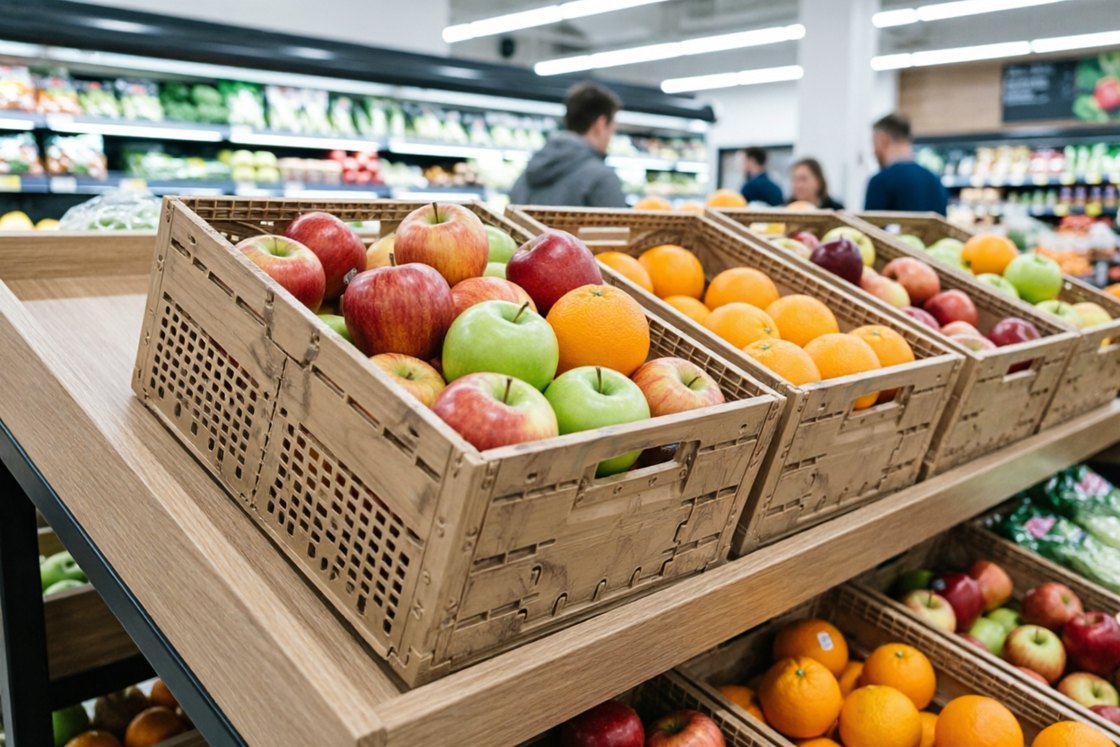
JW-21A crates in the wood-tone finish working as produce bins on a retail display table.
Because the footprint matches global retail shelf standards, the crate drops into existing supermarket and grocery layouts without re-modelling the fixture. Buyers usually shortlist it for three jobs at once: bulk produce storage in the backroom, front-of-store display, and turnover between the two.
Key specifications at a glance:
| Model | JW-21A foldable plastic crate |
| Material | Virgin PP (polypropylene) |
| Colors | Wood tone / matte black |
| Base size | 600 x 400 mm |
| Height options | 100 mm / 175 mm / 200 mm |
| Structure | Foldable / stackable / nestable |
| Applications | Supermarket, grocery, farm market, bakery, warehouse |
Why the 600 x 400 mm Footprint Matters
600 x 400 mm is the modular footprint that European retail logistics is built around, because it divides evenly into the common 1,200 x 800 mm pallet: two crates along the long side, two across the short side, four per layer with no overhang. That is why a crate with this base moves from a distribution pallet to a shop floor shelf without repacking.
For a buyer this has one practical consequence. If your operation already runs 600 x 400 mm crates, adding JW-21A needs no change to pallet patterns, roll-cage planning or shelf bay widths. If it does not, switching to this footprint is usually the cheapest way to make backroom and shop floor use the same grid.
Three Heights, One 600 x 400 mm Footprint
All JW-21A variants share the same 600 x 400 mm base but ship in three wall heights: 100 mm for shallow counter display, 175 mm as the everyday produce depth, and 200 mm for deeper bulk fill.
In practice the three heights cover the full produce journey: shallow trays hold loose items at the checkout zone, mid-height bins carry everyday fruit and vegetable volume on the sales floor, and the tallest walls handle heavier backroom stock. One footprint across all of them keeps pallet plans and shelf bays predictable.
How We Build and Check This Crate
JW-21A is injection moulded in-house on precision machines, then assembled and inspected in the same plant. Our documented production flow for retail fixtures runs raw material inspection, cutting, injection moulding, welding, surface finishing, semi-finished inspection, metal and plastic assembly, finished goods inspection and packing. Two checkpoints in that flow decide whether a folding crate feels right in a store:
- Fold hinges and interlocking edges. These are the thin, highly loaded features of the moulding. Any flash or short shot here is what makes a crate stiff to fold, rattle when carried, or sit proud on the one below it.
- Base and side perforations. Blocked or ragged holes reduce airflow, slow drying after washing, and can leave sharp edges that catch on produce or gloves.
When you evaluate a sample, that is what to feel for: fold and unfold it repeatedly and check that the motion stays smooth and that the panels lock without force, then look along the perforated base for consistent, clean holes. Raw material is inspected before it enters storage and finished goods are checked before packing, but a sample in your own store is still the fastest way to confirm the crate fits your produce and your staff.
Folds Flat When Empty, Works Hard When Full
The side panels collapse flat in seconds with no tools. That single mechanic changes the economics of the empty leg of the cycle: folded crates stack into a fraction of their assembled volume, which cuts warehouse space, return-transport volume and storage cost between seasons.
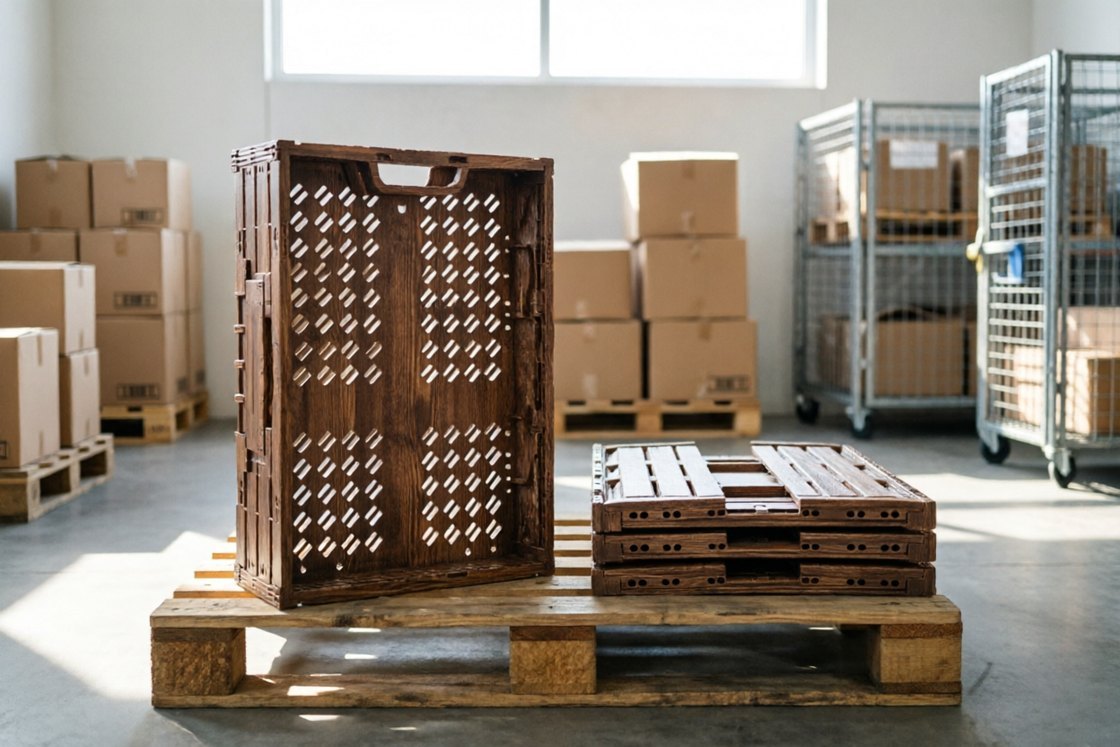
One assembled crate beside a stack of folded-flat units on a backroom pallet.
The photo shows the difference directly: one assembled crate beside a stack of folded-flat units on the same pallet. That gap in occupied volume is what frees up shelf space in a stockroom that is already tight.
Folding and unfolding need no extra tools, and the folded units stack safely for storage. The only caution is the same one printed in the product FAQ: do not place heavy loads on fully folded crates, to avoid deforming the panels.
Vented Panels Keep Produce Fresher
Both the side walls and the base are perforated, so air keeps moving through the load even after the crate is stacked. Continuous circulation around fruit and vegetables reduces moisture build-up, which is the main enemy of shelf life during display and short-term storage.
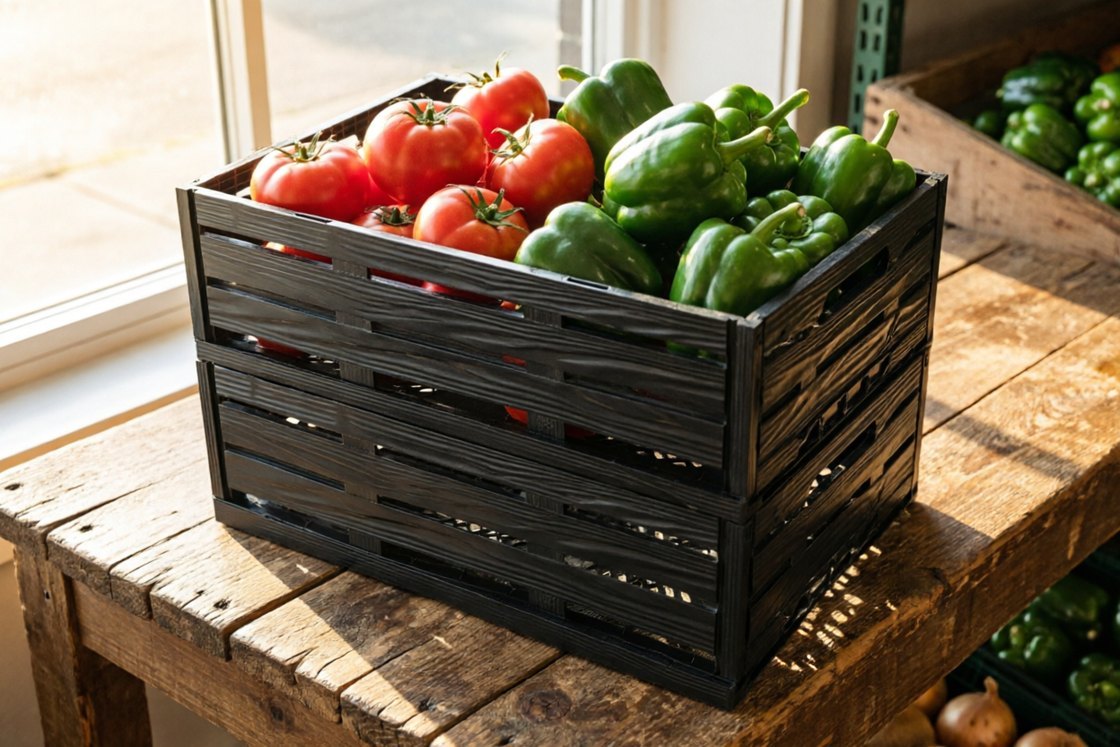
The matte black finish in a fresh corner, filled with tomatoes and peppers.
The molded PP material adds three properties that matter in fresh food service: impact resistance for daily turnover, moisture-proof walls that wash down cleanly, and food-safe reusability across long commercial cycles. One crate replaces many single-trip boxes over its life.
Virgin PP is used rather than regrind because the fold geometry has to stay stable: consistent melt behaviour gives predictable shrinkage, so hinge lines and interlocking edges repeat from the first crate of a run to the last.
Stack Full, Nest Empty
Precision-molded interlocking edges let loaded crates stack stably on top of each other, so a full column of produce travels and displays as one unit. When crates come back empty, the same geometry lets them nest inside each other instead of stacking over them.
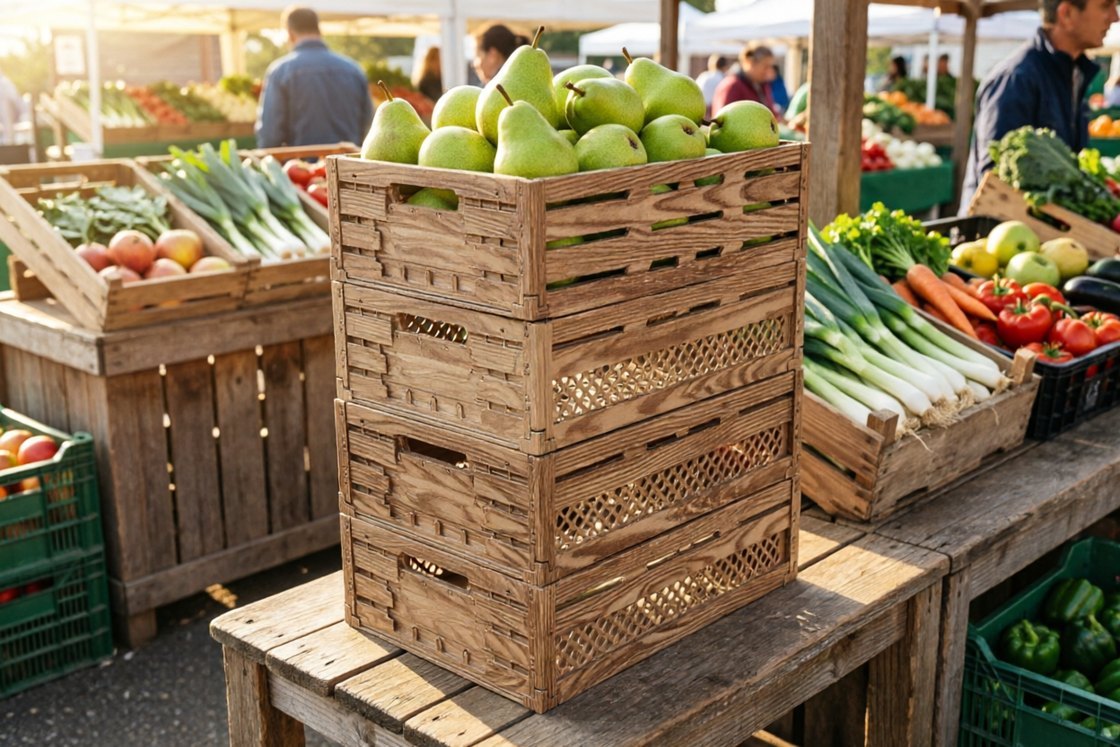
A three-high stack of wood-tone JW-21A crates carrying pears at a market stall.
On the sales floor, a stacked column of crates behaves like a small island display: tall enough to be seen across the aisle, short enough to restock from a cart. The interlocking edges stop the upper crate sliding, even when a shopper lifts produce from the top bin.
For buyers, the useful way to read this is by direction of flow. Outbound to the store, crates stack and carry product. Back to the warehouse, they nest and occupy a fraction of the space. The switch between the two modes takes seconds and needs no tools or separate accessories.
Pairing JW-21A With a Produce Display Rack
The crate is at its best when it is not sitting on a flat shelf at all. VIGO DISPLAY pairs the JW-21A with a dedicated produce display rack: a steel frame with tilted shelves and casters, where each shelf holds one crate angled toward the shopper. The combination turns a storage bin into a self-merchandising produce fixture.
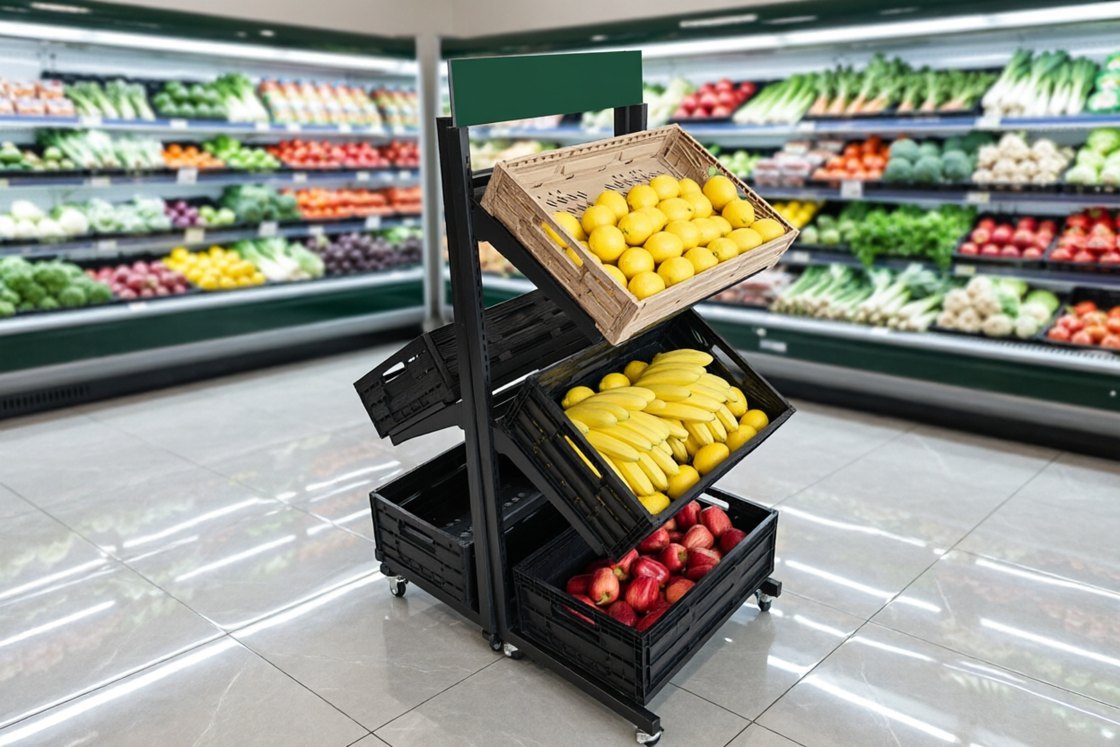
The JW-21A seated on a tilted-shelf display rack, mixing wood-tone and matte black crates.
Three details make the pairing work. The 600 x 400 mm base matches the rack shelf pitch, so crates seat firmly without adapters. The tilt angle keeps produce visible and gravity-feeds to the front as stock sells down. And the vented panels stay effective on the rack, because air still passes through the crate base even when it is angled.
Because the rack rolls on casters, staff can wheel the whole loaded unit from backroom to sales floor in one move, which is where the fold-flat and stacking features pay off twice a day.
If you are planning the layout, the pairing rule we use is simple: one rack per produce category, one crate height per rack level. Mixing heights across a single tilted level makes the front edge uneven and wastes the gravity-feed effect.
Selection Notes From Store Rollouts
Three practical choices come up on almost every project, and this is how we advise on them:
- Pick height by crop, not by looks. 100 mm for soft fruit, berries and small items where a deep pile crushes itself; 175 mm for everyday apples, citrus and peppers; 200 mm for bulky root vegetables, cabbage and backroom picking.
- Pick finish by zone. Wood tone reads warm and natural in farm-market style fresh zones and bakery corners. Matte black hides scuff marks and reads modern in convenience and premium formats.
- Keep one footprint across the fleet. Standardising on 600 x 400 mm means pallet patterns, roll cages and shelf bays stay valid when you add crates or swap racks later.
Day to day, cleaning is straightforward: rinse or wipe with mild detergent and let the crate drain. The perforations are there so water leaves quickly instead of pooling in the base, which is part of why the crate dries fast enough for a same-day return to the floor.
Limits: What This Crate Is Not For
Being clear about the limits saves a lot of returned samples, so these are the four boundaries we state up front:
- No heavy loads on folded crates. Folded flat, the crate is a storage shape, not a load-bearing one. Do not stack weight on fully folded units or the panels will deform.
- Not a high-temperature container. PP is not an oven-safe material and is not intended for hot-fill or heated display.
- Not liquid-tight. The base drains by design. Do not rely on it to hold melting ice or liquids.
- Permanent outdoor use needs the right grade. Standard PP left in direct sun year-round will fade and lose toughness over time. For outdoor market stalls, ask us about UV-stabilised material.
We also do not quote a single kilogram figure for the crate in this article. Safe stacking depends on what you load, how high you stack and how long it stands, so ask us for the load guidance that matches your stacking height before you commit to a rollout.
Where the JW-21A Fits Best
Across the four scenarios documented for this model, the crate covers the produce cycle end to end:
- Supermarkets. Fresh goods handling inside retail zones, with ventilation and stackability for daily stock arrangement.
- Fresh produce warehouses. Space-saving folding when empty, supporting safe turnover and temporary storage of fruit and vegetables.
- Local farmers markets. Sturdy holding for farm harvests, with a ventilated base keeping goods aired during on-site display.
- Grocery distribution centers. Stacking for bulk transit, with the collapsible structure cutting the occupied volume of empty return shipments.
Frequently Asked Questions
Can the crate be folded when not in use?
Yes. It collapses flat without tools, which cuts the volume it occupies in the warehouse and on return shipments. Do not place heavy loads on fully folded crates.
What material is it made from?
Virgin PP (polypropylene). It gives impact resistance for daily handling, moisture-proof walls that wash down cleanly, and reusability across long commercial cycles.
Is it suitable for fresh fruit and vegetables?
Yes. The perforated base and side panels keep air moving around the load, which reduces moisture build-up and helps produce hold condition during transport and display.
Can loaded crates be stacked?
Yes. The interlocking edges are moulded so loaded crates stack safely. Confirm the load guidance for your stacking height with us before a full rollout.
Can I mix heights and colors in one order?
MOQ is 100 pcs per model. Send us the split you want and we will confirm what can ship together in one production run and one container.
Can it be customised with our logo?
Yes. Logo and structural changes carry the same 100 pcs per model MOQ as catalogue items; only tooling is quoted separately. See our Customization Service page.
Ordering Summary
JW-21A is available in both finishes and all three heights. The standard commercial terms are:
| MOQ | 100 pcs per model |
| Sample lead time | 7 days |
| Mass production | 25 days after sample confirmation |
| Freight options | Sea 20-40 days / air 5-10 days / express 3-7 days |
Full product details and enquiry contact: JW-21A Foldable Plastic Crate product page. For installed examples, see our retail case studies.